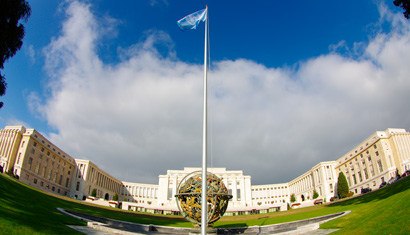
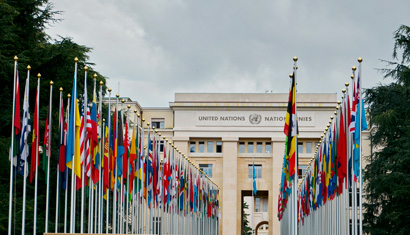
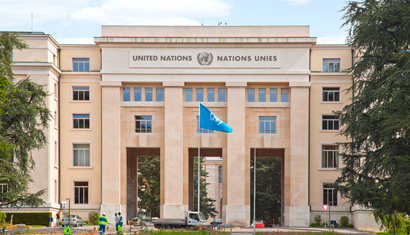
Our strategic presence in Geneva sets us apart as the sole NGO exclusively committed to economic, social, cultural, and environmental rights. This permits us to play a pivotal role in promoting and protecting these rights globally.
Launched at a gathering of outgoing and incoming UN Special Procedure Mandate Holders in Geneva, the resource is designed to support the work of human rights practitioners; in particular UN special procedures mandate holders, treaty bodies and other agencies. It synthesizes and provides an analysis of the UN treaty body pronouncements – concluding observations and general comments – in relation to corporate human rights violations.
GI-ESCR: Our top five ESC rights priorities for the High Commissioner for Human Rights
Global Initiative for Economic, Social and Cultural Rights: Our top five ESC rights priorities for the High Commissioner for Human Rights Having been in office for three months now, the new High Commissioner for Human Rights, Mr Zeid Al-Hussein, will be well advanced in identifying his priorities for his term as High Commissioner. So we think it is timely to offer our top five suggestions for advancing economic, social and cultural (ESC) rights during his term.
The High Commissioner’s recent statement to the General Assembly in presenting the annual report of the work of his Office[1] had an encouraging emphasis on economic, social and cultural rights and evidenced a nuanced understanding of the interdependence of all rights and of the role of ESC rights in crisis and conflict causation and prevention. Highlighting two ‘looming tragedies’, Ebola and climate change, the High Commissioner acknowledged that ‘failure to address systemic and systematic denial of economic, social and cultural rights may be not only a causal factor ….., but also among its far-reaching consequences’.
We couldn’t agree more. However, we are concerned by the tendency of States and multilateral institutions to prioritise civil and political rights over ESC rights, even 20 years after the Vienna Conference and the commitments made to universality and indivisibility. We are keen to see the continued high-level promotion of ESC rights by the Office. Here are our top five suggestions regarding ESC rights during the High Commissioner’s term.
Promoting economic, social and cultural rights
We think it is important for the Office to continue to reinforce the key principles emanating from the Vienna Declaration, namely the universality, indivisibility and interdependence of all rights. All rights – civil, cultural, economic, political and social – should be given equal attention by States and UN agencies, and the seriousness and devastating impact of ESC rights violations must be acknowledged.
We encourage the High Commissioner to continue to promote the ratification of the OP-ICESCR, as the growth and success of that complaints mechanism will substantially improve the understanding and acceptance of ESC rights through jurisprudence and put to rest any remaining questions about justiciability. It will also enable a closer and more sophisticated consideration and application of concepts such as ‘progressive realisation’ and ‘reasonableness’ which will assist in refining State strategies for implementation of ESC rights.
The High Commissioner is well-placed to highlight the underlying ESC rights violations as both causes and consequences of many conflicts and violence. This approach opens up opportunities to advocate for the realization of ESC rights as a means of conflict prevention. This is particularly pertinent when considering the impact of climate change which many commentators are predicting will lead to significant violent conflicts over scarce resources within the next generation.
The High Commissioner has already taken a lead in highlighting the role of the failure to realize rights to health care, food, livelihoods and housing and access to information, in fuelling the Ebola epidemic. He said ‘Ebola thrives at the intersection of chronic poverty, failure to deliver adequate public services, and failures of public trust in the authorities.’[2] Similar leadership in advocacy in relation to climate change and human rights will be vital in the coming year, as the States Parties to the UN Framework Convention on Climate Change meet in Lima (COP 20 in December 2014), with the goal of adopting a new legal instrument on climate change at its meeting in Paris in December 2015 (COP 21).
Frequently, human rights defenders come under attack when working to defend ESC rights, and in particular rights over key resources. Labor rights activists and land and environmental rights advocates are the first and second most ‘at risk’ categories of human rights defenders, according to the Special Rapporteur on Human Rights Defenders.[3] Again, promotion of ESC rights at the national level, and particularly the principles of transparency and participation in decision-making, could help to reduce conflicts and risks for ESC rights defenders.
The High Commissioner and his Office can also play a very constructive role by helping States to understand how to implement their ESC rights obligations. The obligations to respect and protect have historically received greater attention, but the obligation to fulfill ESC rights needs increased focus and attention. We suggest, for example, encouraging field offices to work with States on the positive ESC rights obligations associated with the obligation to fulfill. This can be done, for instance, by utilizing some of the excellent practical tools and information available to assist States, such as the Handbook on Realizing the Rights to Water and Sanitation recently developed by the Special Rapporteur on the right to water and sanitation, and the Guidelines on Security of Tenure developed by the Special Rapporteur on the right to adequate housing. Both offer practical guidance on how States can better meet their obligations to fulfill ESC rights at the domestic level.
Defending women’s economic, social and cultural rights
Critical to the alleviation of poverty and disadvantage across the world is the promotion and protection of women’s ESC rights. The feminized face of poverty is testament to the persistent discrimination against women in law and practice in the area of ESC rights, such as access to land and productive resources, secure housing, access to sexual and reproductive health care and information and access to education. There is ample evidence to demonstrate that securing women’s equal ESC rights can have a transformative impact on the lives of poor women and consequently the lives of their children, families and communities.
For instance, research evidence suggests that secure land rights for women may help prevent the spread of HIV/AIDS by promoting women’s economic empowerment, thereby reducing their vulnerability to some forms of gender-based violence and exploitation, unsafe sex, and other AIDS-related risk factors.[4] Research also suggests that women with secure rights to land are much less likely to report experiencing physical and psychological violence within the context of their intimate partner relationships.[5] Studies have also linked women’s land, property and productive resource rights to better health, nutritional and educational outcomes for their children.[6]
Successful strategies for securing women’s ESC rights must involve combating the persistent harmful gender stereotypes and deeply embedded social norms and practices which discriminate against women in all areas of their life. It will also involve firmly responding to the recent, damaging backlash against the universality of rights and attempts to undermine the human rights of women (and other groups). This is occurring at the international level in the Human Rights Council and at the domestic level, for instance in relation to continuing resistance to women’s sexual and reproductive rights, and equal rights to property and land. It is occurring both in human rights treaty body reviews where female genital mutilation continues to be defended by some States and in related UN fora such as WHO (where the established definition of violence against women was recently questioned) and in the Commission on the Status of Women, where States in recent years have been unable to agree on consensus language upholding women’s rights, thereby undermining basic principles of gender equality. Most notably we have seen a large group of States pursuing a ‘traditional’ or ‘family values’ agenda which seeks to subvert the rights of individuals within the family, usually women, to the ‘greater good’ of maintenance of tradition and the family.
This is an issue that affects rights in all areas, impeding progress at the international level and preventing transformative change in both law and practice at the national and local levels.
We think it is crucial that the High Commissioner and his Office show very strong leadership on these issues and be vigilant in countering statements and moves to rollback progress and undermine universality. If ‘traditional and family values’ continue to garner support at the expense of fundamental individual human rights, the foundations of the system will be diminished and many of the hard-won gains in women’s rights (and LGBT rights) will be at risk.
Human rights and the post-2015 development agenda
The Office and former High Commissioner did a lot of great work in urging the integration of the universally accepted human rights norms and principles into the work on the post-2015 development agenda and the sustainable development goals (SDGs).
The next year is a critical time and a once-in-a-generation opportunity for transformational change as the post-2015 process enters its final stage of intensive State negotiation with final agreements to be reached in September 2015. The SDGs will determine global development policy and influence national strategies and priorities, for the next 15 years.
We would highlight 3 priorities:
ensure that human rights principles are integrated into the proposed sustainable development goals;
ensure that discrimination and inequalities, both within and between countries, are directly addressed; and
ensure that effective human rights based monitoring and accountability mechanisms are incorporated.
The failure of the original MDGs to pay attention to inequalities is one of their greatest failings. For many of the goals, progress was heralded on the basis of national statistics, whilst ignoring the significant lack of progress for certain groups: often women and girls, people in rural areas, persons with disabilities, minorities and other marginalized groups. We know that inequality is on the rise globally and there is ample evidence of the links between greater equality within societies and healthier, happier, more cohesive, less violent, societies and sustainable economic growth. Whilst inequalities have been addressed in the draft SDGs, sustained advocacy is required to ensure that these measures are not watered-down and that they link to the human rights principles of equality and non-discrimination (and therefore benefit from the substantial body of jurisprudence on their meaning and implementation) and that the collection of appropriate disaggregated data to capture systemic discrimination is integrated into the targets and implementation plans.
We have also seen how the lack of access to justice and effective accountability mechanisms in the original MDGs has in part caused their relatively modest progress. States and other powerful actors must be answerable for the new SDGs in order to avoid a similar fate where long-term sustainable development goals are sacrificed to short-term economic demands. This last point remains the biggest deficiency of the current draft SDGs: no specific accountability mechanism is identified.
We would encourage the High Commissioner to continue his predecessor’s strong advocacy in this respect and redouble efforts to ensure that human rights are not side-lined in political negotiations. We think the High Commissioner can play a pivotal role in engaging with States to convince them of the benefits of integrating a human rights approach and in particular the value of the well elaborated human rights principles of: participation, equality and non-discrimination and accountability.
Human rights and the economic sphere
Economic and social rights will continue to go unrealized for millions of poor people around the world without tackling the inequities in the global economic systems. Despite the very clear links between human rights impacts and actors in the economic sphere, the economic sphere has proved to be somewhat impermeable to human rights approaches and advocacy in the past, in part as a function of differences of culture, priorities, conceptual frameworks and technical capacities. However, recent years have seen strong human rights advocacy in various economic policy discussions, such as in relation to: tax justice; oversight of international financial institutions; human rights budgeting; the restrictive provisions of bi-lateral investment treaties; and the impacts of so-called ‘vulture funds’.
This is an issue that the OHCHR has recognized as important in its ‘Thematic Strategies’ which will guide its work for the coming three years. Further, a number of special procedures mandate holders and treaty bodies are directly tackling these issues[7] and it’s vitally important to give this work greater prominence. We encourage the OHCHR to promote a broad understanding of the application of human rights obligations, which encompasses the economic sphere and advise and support domestic policy makers to apply human rights to economic policies and processes, in particular the principles of transparency, participation and accountability.
The global financial crisis and austerity policies in Europe brought these issues to the fore and highlighted in a very direct way the impact of economic policy on ESC rights. Civil society groups provided strong critiques of the complete failure of governments to consider human rights in their policy responses to the global financial crisis and advocated for the inclusion of human rights considerations into the discussion. Indeed, human rights advocates have found that, in order to rise to the challenge, it is imperative to provide greater clarity and specificity about how to tackle the crisis in a human rights compliant manner. Some excellent work has been done in this regard which can help others to sharpen their analysis and recommendations in order to ensure a consistent and coherent human rights response to global financial crisis and austerity policies.
Again, leadership from the Office on these issues, together with greater technical capacity to participate in discussions happening in the economic sphere, would assist to normalize the inclusion of human rights considerations in key international economic fora and develop a more sophisticated dialogue between the economic and human rights spheres.
Non-State actors and Inter-Governmental Organizations
In an increasingly globalized world, with private actors searching for new investment opportunities in emerging markets, the proliferation of State and donor-led policies of privatization of public services and the proliferation of new multi-lateral financial institutions which is aiding a race to the bottom in social and environmental standards, the role of non-State actors and inter-governmental organizations such as the World Bank in both the fulfillment of human rights and in human rights abuses must be urgently and critically examined. Increasing attention has been focusing on the role of non-State actors, including corporate and business actors and international financial and development institutions, in human rights abuses in recent years.
Within the UN human rights system we have seen most treaty bodies addressing non-State actors through Statements, General Comments and in Concluding Observations for State reviews. Many Special Rapporteurs have also raised these issues in their reports and in response to communications. These mechanisms have drawn attention to the role in promoting and protecting human rights of business actors including State owned enterprises, international financial institutions such as the World Bank and development institutions, multi-lateral organisations including UN agencies, and overseas development assistance bodies. With the emergence of new lenders at the State level (eg: China) and the multilateral level (eg: new BRICs development bank), the current environment for international financial institutions is more competitive and IFIs are reacting by reducing the rigor of their social and environmental standards to try to attract more borrowers. An example is the European Bank for Reconstruction and Development which reviewed its standards earlier this year watering down human rights protections.[8] Yet, the decisions of these multi-lateral actors have significant impacts on the ESC rights of millions of people across the world.[9]
Civil society has long campaigned for greater regulation and accountability of business actors including those acting across national borders, and more recently States have begun to take substantive steps to address these issues.[10] Significantly, the Human Rights Council has responded to these issues through the endorsement of the UN Guiding Principles on business and human rights (GPs), the establishment of the Working Group on the issue of human rights and transnational corporations and other business enterprises and a number of resolutions culminating in the establishment of an Inter-Governmental Working Group (IGWG) mandated to elaborate a treaty on transnational corporations and human rights.
The GPs and the IGWG process for a treaty on transnational corporations are important advances towards the goal of accountability of business for human rights abuses, but the GPs of course are unenforceable and the IGWG process is likely to be a long, difficult and political process, given the politics involved in its establishment. Given this and the heated and highly political environment surrounding the Human Rights Council resolutions on business and human rights in June this year, this topic is at a critical juncture and could benefit from high-level attention to ensure that the work of the two initiatives just mentioned are complementary.
In the meantime, work on the accountability of non-State actors should continue beyond but in line with these two processes. We consider the areas requiring greater attention to include:
Access to justice and remedies for violations, including ESC rights violations, and in particular the cross-border human rights impacts of non-State actors. If this issue is not addressed, a very large proportion of victims of rights abuses, particularly ESC rights abuses, will continue to go unremedied. The OHCHR report on access to domestic remedy highlighted many of the problems, but we now need to identify solutions, which must include consideration of ESC rights violations and ‘home’ States ensuring the availability of remedial mechanisms for overseas victims of violations involving their registered business entities.
State extra-territorial obligations under human rights treaties, which oblige States to consider the extra-territorial human rights impacts of non-State actors, including:
The impacts of corporations registered in their territories but operating overseas;
The impacts of international financial institutions they are a member of;
The impacts of State-owned enterprises operating overseas;
The impacts of overseas investments of State investment entities.
The UN human rights treaty bodies and Special Procedures mandates are already highlighting the importance of these obligations and some States are turning their attention to them. However, more needs to be done to promote the existence of these obligations and to encourage States to incorporate human rights due diligence, monitoring, accountability and access to remedy into their corporate regulatory frameworks and ODA bodies.
Privatization of public services is increasingly the preferred policy of many States, yet in many cases this policy is adversely impacting universal access, exacerbating structural inequalities and failing to prioritize the most disadvantaged people.[11] It is largely going unregulated and unmonitored but is having significant and long-term impacts – often detrimental – on the rights to health, education, food, water and sanitation. Greater attention needs to be paid to investing in and strengthening public services and ensuring that the fulfillment of rights to food, water, sanitation, housing, education and health, when provided by private actors, is human rights compliant.
These are our suggested ‘top five’ priorities for ESC rights for the High Commissioner as he plans his work during his first term in office. Undoubtedly you will have others of equal importance and impact which we would be interested to hear about.
Lucy McKernan UN Liaison, Global Initiative for Economic, Social and Cultural Rights November 2014
[1] Statement by the UN High Commissioner for Human Rights, Zeid Ra’ad Al Hussein, to the UN General Assembly 69th session, New York, 22 October 2014. See http://www.ohchr.org/EN/NewsEvents/Pages/DisplayNews.aspx?NewsID=15198&LangID=E
[2] Press conference by United Nations High Commissioner for Human Rights, Zeid Ra'ad Al Hussein, 16 October 2014. See http://www.ohchr.org/EN/NewsEvents/Pages/DisplayNews.aspx?NewsID=15173&LangID=E
[3] A/HRC/4/37 at para 49
[4] Strickland, R. (2004).To Have and To Hold: Women’s Property and Inheritance Rights in the Context of HIV/AIDS in Sub-Saharan Africa. International Center for Research on Women (ICRW) Working Paper. See also: Panda, P., (2002). Rights Based Strategies in the Prevention of Domestic Violence. ICRW Working Paper No. 344.
[5] Gupta, J. (2006). Property Ownership of Women as Protection for Domestic Violence: The Best Bengal Experience, in ICRW (2006) Property Ownership and Inheritance Rights of Women for Social Protection – The South Asia Experience, at 45.
[6] Smith, L., Ramakrishnan, U., Ndiaye, A., Haddad, L. & Martorell, R. (2003). The importance of Women’s Status for Child Nutrition in Developing Countries. International Food Policy Research Institute Research Report 131, 58, 60, 79 ; Gomez, M. and Tran, D.H. (2012), Women’s Land and Property Rights and the Post-2015 Agenda, Official Back-ground Paper – Global Thematic Consultation on Addressing Inequalities, p.10.
[7] See for example the Report of the Special Rapporteur on extreme poverty and human rights on fiscal and taxation policies, UN Doc A/HRC/26/28, here http://daccess-dds-ny.un.org/doc/UNDOC/GEN/G14/033/74/PDF/G1403374.pdf?OpenElement
[8] See for example: http://www.hrw.org/news/2014/03/05/european-bank-reconstruction-and-development-draft-environment-and-social-policy-ret
[9] See for example: http://www.amnesty.org/en/news/nigeria-world-bank-panel-turns-its-back-forcibly-evicted-community-2014-07-18
[10] Although there is a long history of failed attempts by States to put in place a form of international oversight of corporations.
[11] See for example the recent report of the Special Rapporteur on the right to education, Mr Kishore Singh, UN Doc A/69/402.
By Lucy McKernan, Global Initiative on Economic, Social and Cultural Rights
In the build up to the third UN Forum on Business and Human Rights, ISHR will publish a series of articles by key human rights defenders and experts in this field, before launching a special edition of its Human Rights Monitor on 1 December, in both English and Spanish. Click here to join our Spanish language mailing list.
Lucy McKernan addressed the UN Forum on Business and Human Rights on 2 December 2014
For human rights defenders working on children’s rights or corporate accountability issues, the General Comment[1] on business and children’s rights[2] by the Committee on the Rights of the Child (CRC) has a lot to offer. It provides a detailed and progressive explanation of State obligations with respect to business impacts on children’s rights, offering fertile ground for human rights advocates to engage with the Committee and with States on rights abuses involving business.
The focus of the General Comment is on State obligations under the Convention on the Rights of the Child, with respect to impacts on human rights by business operators and activities within its territory and business activities outside its territory but undertaken by its domiciled business entities.
The Committee takes a comprehensive approach such that it covers a very wide variety of actors, situations and issues and importantly prescribes in detail what States should do to ensure direct domestic legal accountability for business human rights abuses. For instance, in recognition of the role played by international organizations (eg: World Bank, IMF, WTO) in rights abuses and impacts and the intertwining of international organizations and business in large scale development projects, the General Comment addresses international organisations. States are reminded that they must comply with their Convention obligations when acting as members of such organizations and in the field of development cooperation,[3] including ‘in their decision-making and operations, as well as when entering into agreements or establishing guidelines relevant to the business sector.’
International organizations ‘should put in place procedures and mechanisms to identify, address and remedy violations ….. including when they are committed by or result from the activities of businesses linked to or funded by them.’[4] This is significant since, despite a number of treaty bodies insisting on State obligations extending to the context of international organisations, many States and international organizations continue to deny the direct applicability of human rights obligations in this context. This was evidenced recently in the rolling back of rights protections in the World Bank’s draft social and environmental safeguards policies.[5]
The General Comment’s broad and comprehensive approach also means that the door is open for issues not solely about children to be brought before the Committee. For instance, the General Comment talks about land dispossession (impacting whole communities, including children) involving business actors,
By way of example, GIESCR and its partner NGOs recently highlighted the issue of the impact of privatization in education on children’s right to education in Morocco
using General Comment 16 to support our arguments that States have an obligation to ensure that privatization in education does not lead to extreme inequalities. The Committee questioned Morocco about this during its review and followed up with strong Concluding Observations condemning the impact of privatization in education on children’s right to education.
Another important issue addressed by this General Comment which presents advocacy opportunities, is extra-territorial obligations (ETOs).[15] The extra-territorial reach of human rights treaty obligations is contested by many States, despite the growing body of treaty body jurisprudence[16] affirming such obligations. Yet for many victims of rights violations involving business, international human rights protections will remain meaningless unless they operate across borders. In recognition of the difficulties of achieving corporate accountability due to complex legal structures and cross-border nature of business, the Committee has detailed the distinct obligations of both home[17] and host[18] States with respect to children’s rights.
For instance, contrary to current home State practice of reducing opportunities for foreign victims to bring claims in their domestic Courts, General Comment 16 says home States must enable access to effective remedy for foreign victims of human rights violations by business ‘where there is a reasonable link between the State and the conduct concerned.’[19]Another expansive interpretation of ETOs is the requirement that States ensure export credit agencies ‘take steps to identify, prevent and mitigate any adverse impacts the projects they support might have on children’s rights before offering support to businesses operating abroad.’[20]
These issues were addressed in the CRC’s review of Australia. The Committee expressed concern about:
Australian mining companies´ participation and complicity in serious violations of human rights in countries such as the Democratic Republic of Congo, the Philippines, Indonesia and Fiji, where children have been victims of evictions, land dispossession and killings. …. about reports of child labour and conditions of work of children that are in contravention of international standards in fishing industry enterprises operated by Australian enterprises in Thailand. [21]
The Committee recommended that Australia:
Examine and adapt its legislative framework ... to ensure the legal accountability of Australian companies and their subsidiaries regarding abuses to human rights, especially child rights, committed in the territory of the State party or overseas and establish monitoring mechanisms, investigation, and redress of such abuses.;
and
establish the mechanisms for the Export Credit Agency of Australia to deal with the risk of abuses to human rights before it provides insurance or guarantees to facilitate investments broad.[22]
There are numerous other useful provisions in General Comment 16 which offer broad advocacy avenues and our experience is that the Committee is receptive to new issues and creative advocacy which highlights serious children’s rights issues involving non-State actors.
A General Comment (also called General Recommendation by some Committees) is a treaty body's interpretation of the content of Convention articles or on thematic issues or its methods of work. General Comments often seek to clarify the reporting duties of State Parties with respect to certain provisions and suggest approaches to implementing treaty provisions.
Committee on the Rights of the Child, General Comment No. 16 (2013) on State obligations regarding the impact of the business sector on children’s rights, UN Doc CRC/C/GC/16.
This refers to the issue of whether States’ human rights treaty obligations extend to persons or activities occurring outside its territorial boundaries. See General Comment 16, para 39 and 42 – 46.
The home State is the State where a corporation, or its parent company, is registered or domiciled. It is usually where the corporation is head-quartered.
The host State is the State where a corporation is undertaking activities or operations, usually through a subsidiary company that is registered in the home State. Usually key decision-making is undertaken by the parent company in the home State and profits are remitted to the parent company in the home State.
UN Committee on the Rights of the Child (CRC), Consideration of reports submitted by States parties under article 44 of the Convention: Concluding observations: Australia, 28 August 2012, CRC/C/AUS/CO/4, para 27.
- See more at: http://www.ishr.ch/news/fertile-ground-corporate-accountability-advocates-crc-general-comment-business-and-childrens#sthash.FIIhG03w.dpuf
Déclaration à la presse 28 Novembre sur le rapport des institutions internationales appelant à la privatisation de l'éducation en Afrique
Pour les personnes présentes à Marrakech pour le Forum Mondial des droits de l'Homme, nous souhaitons vous informer qu'une déclaration importante sera faite demain par les organisations de la société civile en réaction à un rapport récent de la Banque Africaine de Développement (dont le Maroc est membre) et du Programe des Nations qui appelle à soutenir le mouvement de privatisation de l'éducation en Afrique. Ce rapport est essentiel car il émane d'institutions internationales influentes et il pourrait former la base du positionnement des Etats africains pour les négotiations des objectifs du millénaire pour le développement après 2015. Le raport fait des recommandations choquantes et sans précédent auxquelles la société civile à travers l'Afrique réagira de manière forte et unifiée à l'occasion du Forum Mondial des Droits de l'Homme. La déclaration sera faite aux participants du forum thématique éducation et à la presse demain vendredi 28 novembre à13h30 à la salle 6 du village du forum, bab Ighli, Marrakech. Tous les journalistes intéressés et accrédités pour le forum sont invités.
Nous enverrons sous peu le communiqué de presse, sous embargo jusq'à demain 13h30 GMT.
Merci de faire suivre ce message à toute personne intéressée. N'hésitez pas à nous contacter au +212 6 22 37 86 37 pour plus d'informations.
As the end of 2014 draws closer, governments are deciding how the final negotiations on the post-2015 sustainable development agenda will be conducted (the ‘modalities’). The new framework to replace the Millennium Development Goals will be adopted at the United Nations next September and, after extensive preparatory debates and consultations, intergovernmental talks will soon get underway in earnest.
However, there is growing concern that space for the meaningful participation of civil society and social movements will be severely constrained in this final critical phase of negotiations. With this threat in mind, the Post-2015 Human Rights Caucus has sent a letter to the UN Representatives for Ireland and Kenya (co-facilitators of the talks) calling on them to ensure the voice of civil society and grassroots groups are properly heard.
It calls on the two countries and all other Member States to deliver an open, inclusive and transparent process, in which social movements and non-governmental organizations can meaningfully engage. The letter also reminds them that such involvement is not only a human rights imperative, but also a crucial precondition to the success of the new framework.
Participation, transparency, freedom of expression and the right to information are all fundamental components of States’ human rights obligations and commitments. Complying with these standards is necessary to deliver a set of global development goals which reflect the experiences, strategies, needs and desires of individuals and communities. As such, it is likewise crucial to cultivate broad ownership and legitimacy, and thereby provide for the successful implementation of the agenda at both the national and local levels. Member States should seize the opportunity to demonstrate their commitment to an inclusive, transparent post-2015 environment for civil society. • The letter sent by the Post-2015 Human Rights Caucus to the Permanent Representatives of Ireland and Kenya can be downloaded in pdf format here. • This Caucus initiative was led by the Center for Economic and Social Rights (CESR). To learn more about CESR's work on the post-2015 sustainable development goals, see here.
Human Rights Committee addresses housing, water, sanitation and access to land in Palestine and Israel
The Global Initiative for Economic, Social and Cultural Rights (GI-ESCR) welcomes the Concluding Observations on Israel released by the Human Rights Committee today. Relying on the Parallel Reportsubmitted by the Global Initiative for Economic, Social and Cultural Rights, the Human Rights Committee condemned violations of rights related to housing, water, sanitation and access to land. The relevant Concluding Observations also relied on a complementary Parallel Report from Al Haq, particularly regarding access to natural resources and the right to self-determination. The GI-ESCR and Al Haq coordinated their advocacy before the Committee. The Concluding Observations reaffirmed extra-territorial obligations under the International Covenant on Civil and Political Rights (ICCPR) as well as that violations of certain aspects of social rights amount to violations of rights under the ICCPR. It also took a new look at denial of access to land as violating the Covenant.
Bret Thiele, Co-Executive Director of the GI-ESCR, said that "While these Concluding Observations form part of our ongoing advocacy dealing with violations of rights to housing, water, sanitation, food and access to land in Palestine and Israel, this work also fits into our broader strategy of opening additional avenues for enforcement of social rights. By effectively using the principle of indivisibility, interdependence and interrelatedness of all human rights, we hope that advocates now see the International Covenant on Civil and Political Rights as a tool to enforce certain aspects of social rights, particularly since the Individual Complaint procedure under the ICCPR is open to 115 countries." Thiele added that "We have already used the results of similar foundational work to successfully use the Individual Complaint mechanism to enforce the prohibition on forced eviction as well as to get water supply reestablished, and we hope that other civil society organizations consider this additional option for enforcement of social rights."
Regarding housing, the Committee again condemned punitive house demolitions as well as discriminatory forced evictions undertaken in the context of Israel's planning and zoning regime, finding that these practices violate Articles 7, 17 and 26 of the Covenant. The forced eviction and forced relocation of Bedouin communities in both the West Bank and the Negev region of Israel was also condemned, including for not taking into account these communities' traditional pastoral economy, social fabric, and rural way of life, which also rise to violations of Article 27. The Committee called for an immediate halt to forced evictions and house demolitions and effective remedies to victims of destruction of property, forced eviction and forcible transfer. It also called on Israel to ensure the right of participation of the Bedouin communities in any planning that affects them.
On denial of access to water and sanitation, the Committee expressed its concern about the restricted access of Bedouins living in unrecognized and recently-recognized villages in the Negev to basic services, including adequate housing, water and sanitation, healthcare, education and public transportation. It also condemned the blockade of Gaza, in particular its impact on access to food, health, electricity, water and sanitation can called on the immediate lifting of the blockade, as well as the denial of access to water by Palestinians in the West Bank. The Committee reaffirmed that denial of access to food, water and sanitation in these contexts rose to violations of Articles 6, 7 and 26 of the Covenant.
In a new development, the Committee also considered denial of access to land as rising to violations of the ICCPR, including Articles 1, 12 and 17. In doing so, it looked both at the Bedouin's right to ancestral land as well as confiscation of Palestinian land and denial of access to agricultural land by Palestinians in the West Bank including East Jerusalem. The Committee called on Israel to ensure and facilitate non-discriminatory access of Palestinians to land, natural resources, water and sanitation; to ensure that Palestinians have full access to their lands and livelihood; and to put an end to the practice of expropriation of land including for Israeli settlements and the Separation Wall. It also called for the withdrawal of all settlers from the West Bank including East Jerusalem.
The task now is to continue advocacy in Israel, Palestine, Geneva and elsewhere to ensure implementation of these Concluding Observations.
Transcript of Human Rights Committee questioning of Israel is available HERE.
Global Initiative for Economic, Social and Cultural Rights Parallel Report is available HERE.
Global Initiative for Economic, Social and Cultural Rights Parallel Report for the List of Issues is available HERE.
Human Rights Committee Concluding Observations are available HERE.
The UN asks Ghana to explain itself on privatisation in education
Press release, 23/10/2014
(Geneva, Accra) - In a list of issues released last week, the United Nations Committee on the Rights of the Child (CRC) formally asked the Ghanaian Government to explain itself on the growing privatisation in education in the country and the effect it has on the realisation of the right to education for all.
This is a victory for civil society organisations in Ghana that have been researching the detrimental impacts of the mushrooming of private schools. Sylvain Aubry, researcher at the Global Initiative for Economic, Social and Cultural Rights (GI-ESCR) reacted:
“‘Low-cost’ private schools are schools that claim to be affordable and serve poor people. However, research in several countries has shown that they are not affordable. In Ghana, most families have to make sacrifices to send their children to these schools, and in some cases would have to spend up to 40% of their income to send just one child to the school.”
The Committee on the Rights of the Child, the UN body made up of international experts responsible for monitoring implementation of the Convention on the Rights of the Child. As part of its review of the implementation of the Convention by Ghana, it has raised a number of issues, which the Government has to respond to in writing by 24th March 2015.
The CRC required the Government to explain itself on some issues that were raised in a report on privatisation in education in Ghana published by the Ghana Education Campaign Coalition (GNECC) and the GI-ESCR in August this year. In particular the CRC asked Ghana “to provide detailed information on the reasons behind the increase in private education and the low quality of public education, including lack of teachers and teacher absenteeism, in the State party, limiting access to quality education for children who cannot afford private school tuitions”.[1] It also asked Ghana to provide disaggregated data on children attending private schools.
“Access to quality education should not be determined by one’s ability to pay for it. Rapid growth of private schools, including low-cost private schools, will foster social segregation, to the detriment of the most marginalised people. Education is a public good, and not a commodity. Private schools can complement public education but should not replace it”.
This is the second time in a few months that the CRC questions the impact of privatisation in education on the right to education, following recommendations made to Morocco last month to assess the effect of privatisation on the right to education. The UN Special Rapporteur on the Right to Education, Mr Singh, is also expected to highlight this issue on Monday in New-York in his presentation to the UN General Assembly. This reflects the rise of privatisation around the world and the threats it poses for the realisation of the right to education.
The GNECC and the GI-ESCR now hope that the Government will respond accurately and transparently to the questions that have been submitted to them and look forward to a fuller examination of privatisation of education in Ghana during the formal review of the State in June 2015.
The Global Initiative for Economic, Social and Cultural Rights (GI-ESCR) is an international non-governmental human rights organization which seeks to advance the realization of economic, social and cultural rights throughout the world, tackling the endemic problem of global poverty through a human rights lens. See http://www.globalinitiative-escr.org/
The Ghana National Education Campaign Coalition isa network of civil society organizations, professional groupings, educational/research institutions and other practitioners interested in promoting quality basic education for all. Formed in 1999, the coalition has steadily grown over the years with a current membership of over 200 organizations. See http://gneccgh.org/
Human Rights Committee questions Israel on rights related to housing, water, sanitation and agricultural land
Relying on the Parallel Reportsubmitted by the Global Initiative for Economic, Social and Cultural Rights, the Human Rights Committee this week questioned Israel on violations of rights related to housing, water, sanitation and agricultural land. The Report and questioning focused in part on Israel’s failure to implement the previous Concluding Observations adopted in 2010. The2010 Concluding Observations where the result of a Joint Parallel Report submitted by Global Initiative staff, then with the Centre on Housing Rights and Evictions (COHRE), and its partner Al Haq. That Parallel Report resulted in the some of the strongest statements by the Human Rights Committee to date on violations related to housing and the first Concluding Observations under the International Covenant on Civil and Political Rights (ICCPR) related to access to water and sanitation.
This week, on the issue of access to water, the Committee questioned Israel on the lack of access to water for Palestinians living in the West Bank as well as the dangerously low quality of water in the Gaza Strip. In 2010, the Committee found that denial of access to water could amount to a violation of the right to life guaranteed by Article 6 of the ICCPR.
The Committee also questioned Israel on the lack of electricity and water in the context of access to sanitation. It also focused on the right to ancestral land and traditional livelihood of the Bedouin population as well as access of all Palestinians to natural resources including agricultural land. The focus on denial of access to agricultural land was a focus of the GI-ESCR Parallel Report and the questioning on this issue is groundbreaking under the ICCPR.
The Committee again condemned punitive house demolitions as well as forced evictions in the context of construction of Israeli settlements and discriminatory planning and zoning regimes. In 2010, the Committee reaffirmed that forced evictions violate the right to be free from unlawful or arbitrary interference with the home (Art. 17) but also found that they may rise to cruel, inhuman or degrading treatment or punishment in violation of Article 7 of the ICCPR.
The GI-ESCR hopes that the resulting Concluding Observations from this round of periodic reporting will reaffirm that denial of access to, or destruction of, housing, water and sanitation violate the ICCPR, and hopes that the Committee also finds that denial of access to, or destruction of, agricultural land also rises to such violations.
Transcript of Human Rights Committee questions is available HERE.
Global Initiative for Economic, Social and Cultural Rights Parallel Report is available HERE.
Global Initiative for Economic, Social and Cultural Rights Parallel Report for the List of Issues is available HERE.
Human Rights Committee 2010 Concluding Observations are available HERE.
COHRE / Al Haq 2010 Parallel Report is available HERE.
It is the morning of Wednesday 3rd September, at the Office of the High Commissioner for Human Rights headquarter in Geneva. The dice is cast; in a few minutes, we will know. My Moroccan colleague, who represents the Moroccan Coalition on Education for All, and myself, who represents the Global Initiative for Economic, Social and Cultural Rights (GI-ESCR) are waiting anxiously. Will they ask the question? What will the government respond? The moment comes. Ms Amal Aldoseri, a member of the UN Committee on the Rights of the Child (CRC), brings up a number of questions about the education system in Morocco, and finally asks: “Could you explain the impact of the development of private education on inequalities and the right to education in your State?”
We cannot help but feel an inner sense of excitement at what is happening. We are nearing our goal, after of one year of hard work to try to draw attention to the creeping privatization of education in Morocco and its devastating effects. The Moroccan government will finally have to explain why, for more than a decade, it has supported and promoted the development of fee-paying, profit-making, private schools, tripling the amount of students enrolled in private schools, thereby participating to widen the inequalities in access to quality education and further dividing the society between rich and poor.
The government is represented in Geneva by 20-strong Moroccan delegation led by the Minister for Solidarity, Women, Family and Social Development, Ms Bassima Hakkaoui. The delegation came to Geneva to discuss its implementation of the UN Convention on the Rights of the Child, as part of the periodic review that the CRC normally conducts every five years. The government representative in charge of education starts responding to Ms Aldoseri’s questions. He gives a response to all the issues she raised, praising the ‘great progress’ and the achievement of Morocco with regards to education, followed by Ms Hakkaoui, who complements his responses, except…. that they both ignore the question about privatisation in education.
We think that it’s finished, CRC has very little time to conduct the review, privatisation was a small question at the end and may seem to the Committee to be a small issue; the discussion will now move to the next issue, as planned. The government will not give any information, and we’ll have to cross our fingers that the Committee still pays attention to privatisation in education in its written recommendations. But this is when we see someone raising his hand. Mr Hatem Kotrane, a member of CRC from Tunisia, asks a follow-up question on privatisation. Basing himself on statistics from the Ministry of Education that my Moroccan colleague gave him earlier during the break, he wants to know why figures show that most teachers in private schools are also teaching in public establishments. Moment of silence in the room. Another hand is raised. Mr Benyam Mezmur, a member of the CRC, asks an additional follow-up question, and wants to know why the government did not respond to the question on privatisation in education, which is a key point.
The government delegation looks unsure. Someone starts responding, and indicates that Morocco aims at reaching as soon as possible ‘20% of pupils enrolled in private schools.’ Ms Hakkaoui, the minister, follows and praises private education. She indicates that the government ‘promotes free competition in education, which is good for all citizens.’ They both insist that private education is ‘well regulated in Morocco,’ and that ‘no teacher from the public sector teaching in private schools.’ With this last statement, the Moroccan civil society organisations representatives seated next to me cannot help having a semi-amused, semi-shocked reaction, as everyone in Morocco knows that this is simply untrue…
The meeting proceeds, and the discussion is now moving to another issue. CRC members ask a set of questions about the right to health. However, as the government starts responding, Mr Benyam Mezmur, the member of the CRC, raises his hand once again: ‘I don’t usually insist and come back to an issue that has already been discussed, but… was the interpretation not working well, or did I understand well that the government of Morocco is aiming at reaching 20% of pupils in private schools!? Education is a public good, and it’s the responsibility of the government to provide quality education for all! … You say that everything is going well in your education system, but could you at least mention two issues that you’re facing?”
Another moment of silence in the room. Ms Hakkaoui attempts a vague response, but quickly, the inter-ministry delegate in charge of human rights intervenes. With his human rights experience, he perhaps understands better that the discussion is going the wrong way for them, and he eventually admits that the education system is not perfect – though without giving any detail why –, adding that the country is working on a reform of the education system. At this point, we know that we have made a great step forward in our advocacy, and that our efforts of the last 10 months are starting to pay off. The CRC, thanks to its perseverance and precise questions, has forced the government to unveil its support to private education and to publicly show its embarrassment and lack of reflection on the impact it has on the right to education.
How did we get to this point? To reach this moment, these 5 minutes where the Moroccan government has to publicly explain itself about the disastrous effect of its privatisation policies, we have worked for several months. The GI-ESCR and the Moroccan Coalition started in October, thanks to the support of the Privatisation in Education Research Initiative (PERI), by conducting research on the scale and impact of privatisation in education in Morocco. Following this research, we submitted two reports to the CRC in December, ahead of the February CRC pre-session (which is a preliminary review) in February.
From then, we prepared simplified advocacy documents, had a number of meetings with stakeholders in Geneva to raise awareness about this still little-known issue, and actively mobilised and coordinated with civil society organisations in Morocco trough discussions and workshops. We were present in Geneva on the day of pre-session of the CRC, and although we were not invited at the pre-session itself (it’s a closed session only on invitation), we organised with other Moroccan organisations that were invited to attend to raise the issue of privatisation, and we used that opportunity to talk to key stakeholders outside of the session.
We got a first victory when the CRC included in its list of issues, which is a list of written questions that the CRC sends to the States before the review, questions about inequalities in education and the development of private schools. The State responded to these questions in June, but was very vague on the issue of privatisation. We then published a third report, highlighting what was missing in the government’s response.
It is only after this work that we got into Geneva, for the actual review session. At that point, most of the work was done, and we only had to do a final push to raise awareness about the issue. We sat, and waited eagerly for the CRC to ask its questions… The last step was then to try to get people who were not in Geneva – in particular people in Morocco – to know about what happened in that room at the Palais des Nations. Working with a broad network of actors Morocco was essential. We contacted many journalists and got good news coverage, in French, like here, here, here, or there, and in Arabic, like here. The good connexions of our partners in Morocco were very important!
Getting the CRC to question Morocco is not the end of the journey: this is just one State amongst many affected by privatisation, we need to wait to see whether the concluding observations (written recommendations sent to States) that that CRC will publish at the end of September adequately address the issue, and there will then be a lot of work needed to convince the government to implement those recommendations. This is, still, significant. The fact that a UN Committee of human rights experts publicly questions the development of private education and reminds the world that education is a public good is a major step. It is also a formidable message of hope for the thousands of activists who campaign around the world to defend public quality education for all, and beyond, a conception of society where every child can develop their personality, talents and mental and physical abilities to their fullest potential, and where every child learns to live together in an open, tolerant, and vibrant society.
Ana Clara works as a Programme Officer on Public Services with the Global Initiative for Economic, Social, and Cultural Rights. She holds a master’s degree in Human Rights and Humanitarian Action from Sciences Po in Paris, where she focused on economic, social, and cultural Rights, and Latin American and gender studies. She holds a Bachelor of Laws from Universidade Federal de Mato Grosso in Brazil.
Ana Clara previously worked on litigation claims concerning the right to social security and the right to health at the Public Defender’s Office and Federal Court of Justice in Brazil. She also supported the work of the Special Rapporteur on Economic, Social, Cultural, and Environmental Rights of the Inter-American Commission on Human Rights. Recently, she worked on strategic litigation before the Inter-American Court of Human Rights as part of the team of the Center for Justice and International Law.
Ana Clara, country is Brazil (Based in Paris).
ASHINA MTSUMI
PROGRAMME OFFICER -PUBLIC SERVICES & REPRESENTATIVE FOR AFRICA
Ashina works as the Programme Officer for Public Services and Representative for Africa with the Global Initiative for Economic, Social and Cultural Rights. She is an Advocate of the High Court of Kenya, with an LL.B degree from the University of Nairobi, Kenya, and an LL.M (with distinction) in Human Rights and Democratisation in Africa from the Centre for Human Rights, University of Pretoria, South Africa.
Passionate about social justice, she has worked in the human rights sector for over six years at the intersection of global and national struggles for just systems of public service delivery to ensure everyone can enjoy their socio-economic rights, first at the Economic and Social Rights Centre-Hakijamii in Kenya and then at GI-ESCR. In particular, she has led and supported research and advocacy at local, national and global research and advocacy focused on the human rights legal framework relating to the rights to land, housing, education, health and water, for marginalised communities. Her research interests also include human rights and economic policy and the contribution that human rights obligations can make to the formulation and implementation of economic policy.
Ashina is based in Nairobi, Kenya.
BELÉN QUELLET
SENIOR COMMUNICATIONS OFFICER
Belén has a BA in International Relations. She lived in India and the Philippines just after graduating where she volunteered for three years in health and education projects. Upon her return to Argentina, where she is native from, she joined Red Solidaria as volunteer and international aid coordinator. She worked as a journalist and program manager at La Nación newspaper foundation in Buenos Aires, to later become Social Media information specialist at the US Embassy in Buenos Aires. She acted there as Liaison Officer with other sections and became Grant Officer representative. She was selected to become HelpArgentina's Executive Director to help expand fundraising opportunities abroad for NGOs from other Latin American countries, and successfully transitioned the organization into PILAS, Portal for Investment in the Latin American Social Sector. From there she moved on to working at a new media startup, RED/ACCION, as Engagement Editor and Membership coordinator before joining us as Communications Officer.
Belén is based in Buenos Aires, Argentina.
LORENA ZENTENO
RESEARCH ASSOCIATE
Lorena Zenteno is a PhD student at the University of Edinburgh. Her primary research interests include the human rights dimensions of climate change and environmental impacts, climate change justice, gender, and the judiciary’s role in the climate change crisis. Lorena has worked for several years in Chile, as a judge, as a law clerk, in the Court of Appeal of Concepcion, Santiago and in the Constitutional Chamber of the Supreme Court of Chile. She is a member of the Environment and Human Rights Commission of the National Association of the Chilean Judiciary, dedicated to study and discuss climate change and environmental impacts on human rights. Lorena is the Chilean National Rapporteur on Global Climate Litigation database for the Sabin Center for Climate Change Law of Columbia University.
She was a senior researcher for the former UN Special Rapporteur on Cultural Rights, Karima Bennoune, from September 2018 until September 2021. Supported and assisted the UN Special Rapporteur to fulfil his mandate to the UN General Assembly and UN Human Rights Council.
She holds an LL.B. from Universidad de Concepcion, a LL.M. in Environmental Law from the University of Davis, California, and a Master in Business Law from the University Pompeu Fabra, Barcelona, Spain. Lorena is a member of the the Global Network for the Study of Human Rights and the Environment.
Lorena is based in Geneva, Swiss.
ZSUZSANNA NYITRAY
PROGRAMME OFFICER -RIGHT TO EDUCATION
Zsuzsanna works as Right to Education Officer with the Global Initiative for Economic, Social and Cultural Rights. Prior to joining GI-ESCR, she assisted in the drafting process of the Abidjan Principles on the Right to Education and the development and publication process of the Commentary of the Abidjan Principles as a consultant. Previously, she has worked with the Open Society Justice Initiative as an Aryeh Neier Fellow on issues such as equality and non-discrimination, Roma rights, the right to education, economic justice, access to justice and the rule of law. She has also worked as a lawyer with the Hungarian Civil Liberties Union on educational segregation, Roma rights and hate crimes. She holds an LL.M in Public International Law from the University of Edinburgh and a Law Degree from the Eötvös Loránd University Budapest.
Zsuzsanna is based in Budapest, Hungary.
DONATE
If you enjoy our work, please consider making a donation!
No amount is too small. Your contribution will help us fight for transformative change to end endemic problems of social and economic injustice.
The Global Initiative for Economic, Social and Cultural Rights is a 501(c)(3) non-profit organisation. Donations are tax-deductible in many countries, including the United States.
MAGDALENA ROCHI
PROGRAMME OFFICER - CLIMATE AND ENVIRONMENTAL JUSTICE
Magdalena works as Programme Officer on Climate and Environmental Justice for the Global Initiative for Economic, Social and Cultural Rights. She is an international lawyer working on the intersections between human rights, environmental and economic law. Prior to joining GI-ESCR, she worked dealing with the protection of economic and social rights in Argentina, at an NGO focused on strategic litigation and as a clerk in the judiciary. She holds an LL.B. and a JD from the University of Buenos Aires, Argentina, where she specialised in International Law and an LL.M from the Geneva Academy of International Humanitarian Law and Human Rights, Switzerland.
Magdalena is based in Buenos Aires, Argentina.
ASHINA MTSUMI
OFICIAL DE PROGRAMA - SERVICIOS PÚBLICOS Y REPRESENTANTE PARA ÁFRICA
Ashina es oficial del Programa para los Servicios Públicos y Representante para África de la Global Initiative for Economic, Social and Cultural Rights. Es abogada de la Corte Suprema de Kenia, egresada (LL.B) de la Universidad de Nairobi, Kenia, y con un máster (LL.M) en derechos humanos y democratización en África, completado con honores, en el Centro para los Derechos Humanos de la Universidad de Pretoria en Sudáfrica. Ashina es una apasionada de la justicia social, y ha trabajado en el área de los derechos humanos en el marco de las luchas nacionales y mundiales por sistemas más justos de prestación de servicios públicos, que garanticen a todos el disfrute de sus derechos socioeconómicos. Primero trabajó en el Economic and Social Rights Centre de Hakijamii, Kenia, y luego, en el GI-ESCR. Concretamente, ha dirigido y apoyado la investigación y la defensa, a nivel local, nacional y mundial, del marco legal de derechos humanos para los derechos de las comunidades marginadas a la tierra, la vivienda, la educación, la salud y el agua. Sus intereses en la investigación se orientan también a los derechos humanos y las políticas económicas, así como a la contribución que el cumplimiento de los derechos humanos hace a la formulación y ejecución de las políticas económicas.
Ashina reside en Nairobi, Kenia.
ZSUZSANNA NYITRAY
OFICIAL DE PROGRAMA - DERECHO A LA EDUCACIÓN
Zsuzsanna es oficial del Programa de Derecho a la Educación de la Global Initiative for Economic, Social and Cultural Rights. Antes de unirse a GI-ESCR, colaboró, como consultora, en la redacción de los Principios de Abiyán sobre el derecho a la educación, así como en la elaboración y publicación del Comentario de los Principios de Abiyán. Previamente, Zsuzsanna trabajó con la Open Society Justice Initiative como becaria de la Aryeh Neier Fellowship, en temas como la igualdad y la no discriminación, los derechos de los romaníes (Roma Rights), el derecho a la educación, la justicia económica, el acceso a la justicia y el estado de derecho. También ha trabajado como abogada con la Hungarian Civil Liberties en la segregación educativa, los derechos de los Romaníes y los crímenes de odio. Tiene un máster (LL.M) en derecho público Internacional por la Universidad de Edimburgo y una licenciatura en Derecho por la Universidad Eötvös Loránd, Budapest.
Zsuzsanna reside en Budapest, Hungría.
BELÉN QUELLET
SENIOR AGENT DE COMMUNICATION
Belén est titulaire d’un BA en relations internationales. Juste après avoir obtenu son diplôme, elle a vécu en Inde et aux Philippines, où elle s'est portée volontaire pendant trois ans pour des projets de santé et d'éducation. À son retour en Argentine, d'où elle est originaire, elle a rejoint Red Solidaria en tant que volontaire et coordinatrice de l'aide internationale. Elle a travaillé comme journaliste et responsable de programme à la fondation du journal La Nación à Buenos Aires, pour devenir ensuite spécialiste de l'information sur les médias sociaux à l'ambassade des États-Unis à Buenos Aires. Elle y a joué le rôle d'agent de liaison avec les autres sections et est devenue représentante des agents de subvention. Elle a été choisie pour devenir la directrice exécutive de HelpArgentina afin d'aider à développer les possibilités de collecte de fonds à l'étranger pour les ONG d'autres pays d'Amérique latine, et a réussi la transition de l'organisation vers PILAS, le portail d'investissement dans le secteur social latino-américain. Elle a ensuite travaillé pour une start-up de nouveaux médias, RED/ACCION, en tant que rédactrice chargée de l'engagement et coordinatrice des membres, avant de nous rejoindre en tant que responsable de la communication.
Belén vit à Buenos Aires, en Argentine.
ANA CLARA CATHALAT
OFICIAL ASOCIADO DE PROGRAMA- SERVICIOS PÚBLICOS
Ana Clara Cathalat colabora como socia en la Global Initiative for Economic, Social, and Cultural Rights, mientras prosigue con su máster en derechos humanos y acción humanitaria en la Universidad Sciences Po, París. Allí centra su interés en los derechos económicos, sociales y culturales y en estudios de género en América Latina. Tiene una licenciatura en derecho por la Universidad Federal de Mato Grosso, Brasil.
Previamente, Ana Clara trabajó en reclamaciones judiciales relacionadas con el derecho a la seguridad social y el derecho a la salud en la Oficina del Defensor Público y el Tribunal Federal de Brasil. Asimismo, apoyó la labor del Relator Especial en Derechos Económicos, Sociales, Culturales y Ambientales de la Comisión Interamericana de Derechos Humanos. Recientemente, trabajó en litigios estratégicos ante la Corte Interamericana de Derechos Humanos, como miembro del equipo del Centro por la Justicia y el Derecho Internacional.
Ana Clara, Brasil. (Reside en París).
LORENA ZENTENO
INVESTIGADORA ASOCIADA
Lorena Zenteno es estudiante de doctorado en la Universidad de Edimburgo. Entre sus principales intereses de investigación se encuentran el impacto del cambio climático y su efecto ambiental sobre los derechos humanos, la justicia ambiental, el género y el papel del sistema de justicia en la crisis por el cambio climático. Trabajó varios años en Chile como jueza y como asistente jurídico en la Corte de Apelaciones de Concepción, Santiago, y en la Sala Constitucional de la Corte Suprema de Chile. Es miembro de la Comisión de los Derechos Humanos y Ambientales de la Asociación Nacional de Magistrados y Magistradas de Chile, la cual se dedica a estudiar el impacto del cambio climático y su efecto ambiental sobre los derechos humanos. Lorena es la relatora nacional chilena de la base de datos de los litigios por el cambio climático del Sabin Center for Climate Change Law de la Universidad de Columbia.
Trabajó como investigadora principal para la Relatora Especial sobre los Derechos Culturales de las Naciones Unidas, Karina Bennoune, desde septiembre de 2018 hasta septiembre de 2021. Apoyó y asistió al Relator Especial de las Naciones Unidas en sus labores ante la Asamblea General y el Consejo de Derechos Humanos de las Naciones Unidas.
Tiene una licenciatura en derecho por la Universidad de Concepción, un máster en derecho ambiental por la Universidad de Davis, California, y un máster en derecho empresarial por la Universidad Pompeu Fabra en Barcelona, España. Lorena es miembro de la Global Network for the Study of Human Rights and the Environment.
Lorena reside en Ginebra, Suiza.
MAGDALENA ROCHI
PROGRAMME OFFICER - CLIMATE AND ENVIRONMENTAL JUSTICE
Magdalena works as Programme Officer on Climate and Environmental Justice for the Global Initiative for Economic, Social and Cultural Rights. She is an international lawyer working on the intersections between human rights, environmental and economic law. Prior to joining GI-ESCR, she worked dealing with the protection of economic and social rights in Argentina, at an NGO focused on strategic litigation and as a clerk in the judiciary. She holds an LL.B. and a JD from the University of Buenos Aires, Argentina, where she specialised in International Law and an LL.M from the Geneva Academy of International Humanitarian Law and Human Rights, Switzerland.
Magdalena is based in Buenos Aires, Argentina.
DONATE
Si le gusta nuestro trabajo, considere hacer una donación.
Ninguna cantidad es demasiado pequeña. Su contribución nos ayudará a luchar por un cambio transformador para poner fin a los problemas endémicos de la injusticia social y económica.
La Global Initiative for Economic, Social and Cultural Rights es una organización sin fines de lucro 501(c)(3). Las donaciones son deducibles de impuestos en muchos países, incluyendo Estados Unidos.
This website uses cookies to enhance your browsing experience.
OFICIAL DE PROGRAMA - SERVICIOS PÚBLICOS Y REPRESENTANTE PARA ÁFRICA
Ashina es oficial del Programa para los Servicios Públicos y Representante para África de la Global Initiative for Economic, Social and Cultural Rights. Es abogada de la Corte Suprema de Kenia, egresada (LL.B) de la Universidad de Nairobi, Kenia, y con un máster (LL.M) en derechos humanos y democratización en África, completado con honores, en el Centro para los Derechos Humanos de la Universidad de Pretoria en Sudáfrica. Ashina es una apasionada de la justicia social, y ha trabajado en el área de los derechos humanos en el marco de las luchas nacionales y mundiales por sistemas más justos de prestación de servicios públicos, que garanticen a todos el disfrute de sus derechos socioeconómicos. Primero trabajó en el Economic and Social Rights Centre de Hakijamii, Kenia, y luego, en el GI-ESCR. Concretamente, ha dirigido y apoyado la investigación y la defensa, a nivel local, nacional y mundial, del marco legal de derechos humanos para los derechos de las comunidades marginadas a la tierra, la vivienda, la educación, la salud y el agua. Sus intereses en la investigación se orientan también a los derechos humanos y las políticas económicas, así como a la contribución que el cumplimiento de los derechos humanos hace a la formulación y ejecución de las políticas económicas.
Ashina reside en Nairobi, Kenia.
ZSUZSANNA NYITRAY
RESPONSABLE DE PROGRAMME - DROIT À l’ÉDUCATION
Zsuzsanna travaille actuellement en tant que responsable du droit à l'éducation pour l'Initiative mondiale pour les droits économiques, sociaux et culturels. Avant de rejoindre GI-ESCR, elle a participé, en tant que consultante, au processus de rédaction des Principes d'Abidjan sur le droit à l'éducation et au développement et à la publication du Commentaire des Principes d'Abidjan. Auparavant, elle a travaillé avec l'Open Society Justice Initiative en tant que boursière Aryeh Neier sur des questions telles que l'égalité et la non-discrimination, les droits des Roms, le droit à l'éducation, la justice économique, l'accès à la justice et l'État de droit. Elle a également travaillé en tant qu'avocate pour l'Union hongroise des libertés civiles sur la ségrégation scolaire, les droits des Roms et les crimes haineux. Elle est titulaire d'un master en droit international public de l'Université d'Édimbourg et d'un diplôme de droit de l'Université Eötvös Loránd de Budapest.
Zsuzsanna vit à Budapest, en Hongrie.
ANA CLARA CATHALAT
CHARGÉE DE PROGRAMME ASSOCIÉE – SERVICES PUBLICS
Ana Clara Cathalat collabore actuellement, dans le cadre d’une bourse, à l’Initiative mondiale pour les droits économiques, sociaux et culturels, tout en préparant un master en droits de l'Homme et action humanitaire à Sciences Po Paris, où elle se spécialise en droits économiques, sociaux et culturels, ainsi qu’en études de genre et latino-américaines. Elle a une licence de droit de l’Université Fédérale du Mato Grosso au Brésil.
Ana Clara a auparavant travaillé sur des actions en justice relatives au droit à la sécurité sociale et au droit à la santé auprès du Bureau de l’aide juridictionnelle et de la Cour de justice fédérale du Brésil. Elle a également appuyé les travaux de la Rapporteuse spéciale sur les droits économiques, sociaux, culturels et environnementaux de la Commission interaméricaine des droits de l'Homme. Elle a récemment travaillé sur des actions en justice dans des cas stratégiques auprès de la Cour interaméricaine des droits de l'Homme, au sein de l’équipe du Centre pour la Justice et le Droit International (CEJIL).
Ana Clara, le pays est le Brésil (Basée à Paris).
LORENA ZENTENO
ASSOCIÉE DE RECHERCHE
Lorena Zenteno est doctorante à l’Université d’Édimbourg. Ses principaux thèmes de recherche sont les dimensions du changement climatique et des problèmes écologiques relatives aux droits de l'Homme, la justice climatique, le genre, et le rôle de la Justice dans la crise du changement climatique. Lorena a travaillé pendant plusieurs années au Chili, comme juge et comme légiste, auprès des Cours d’appel de Concepción et Santiago et de la Chambre constitutionnelle de la Cour suprême du Chili. Elle fait partie de la Commission de l’environnement et des droits de l'Homme de l’Association nationale de la magistrature chilienne, dont la mission est d’étudier et de débattre des conséquences du changement climatique et des problèmes écologiques sur les droits de l'Homme. Lorena est la Rapporteuse nationale chilienne sur la base mondiale des actions en justice climatiques pour le Centre Sabin pour le droit du changement climatique de l’Université de Columbia.
Elle a occupé le rôle de chercheuse principale pour l’ancienne Rapporteuse spéciale sur les droits culturels de l’ONU, Karima Bennoune, entre septembre 2018 et septembre 2021. Elle a appuyé et soutenu la Rapporteuse spéciale de l’ONU dans l’accomplissement de son mandat conféré par l’Assemblée générale de l’ONU et le Conseil des droits de l'Homme de l’ONU.
Elle a une licence de droit de l’Université de Concepción, un master en droit de l’environnement de l’Université de Davis (California) et un master en droit des affaires de l’Université Pompeu Fabra de Barcelone (Espagne). Lorena fait partie du Réseau mondiale pour l’étude des droits de l'Homme et de l’environnement.
Lorena vit à le Chili, basé à Genève.
DONNER
Si vous aimez notre travail, pensez à faire un don !
Aucun montant n'est trop petit. Votre contribution nous aidera à lutter pour un changement transformateur afin de mettre fin aux problèmes endémiques d'injustice sociale et économique.
L'Initiative mondiale pour les droits économiques, sociaux et culturels est une organisation à but non lucratif 501(c)(3). Les dons sont déductibles des impôts dans de nombreux pays, y compris aux États-Unis.
BELÉN QUELLET
SENIOR OFICIAL DE COMUNICACIONES
Belén es licenciada en Relaciones Internacionales. Apenas se graduó, vivió en la India y en Filipinas, donde fue voluntaria durante tres años en proyectos de salud y educación. Al regresar a su nativa Argentina se incorporó a la Red Solidaria como voluntaria y coordinadora de ayuda internacional. Trabajó como periodista y gestora de programas de la fundación del diario La Nación en Buenos Aires, para luego convertirse en especialista en información de medios sociales en la Embajada de Estados Unidos en Buenos Aires. Allí actuó como oficial de enlace con otras secciones y se convirtió en oficial representante de los programas de subvenciones. Fue seleccionada como Directora Ejecutiva de HelpArgentina con la función de ampliar las oportunidades de recaudación de fondos internacionales de las ONG de otros países latinoamericanos, y logró la transición exitosa de la organización hacia PILAS, Portal para la Inversión Social en Latinoamérica. De allí pasó a trabajar en una nueva empresa de medios de comunicación, RED/ACCION, como editora y coordinadora de membresías, antes de unirse al equipo de la GI-ESCR como oficial de comunicaciones.
Belén reside en Buenos Aires, Argentina.
CAMILA BARRETTO MAIA
DIRECTORA EJECUTIVA
Camila cuenta con más de 14 años de experiencia en abogacía a niveles nacional, regional y multilateral, especializándose en la supervisión de investigaciones y litigios sobre diversos temas de derechos humanos. Ha residido en Buenos Aires, donde trabajó en el Centro de Estudios Legales y Sociales (CELS), coordinando esfuerzos internacionales durante cuatro años. Camila posee una maestría en Administración Pública y Política Pública de la Fundación Getulio Vargas en San Pablo y una licenciatura en Relaciones Internacionales de la Universidad de Brasilia.
Camila reside en Brasilia, Brasil. .
ANA DI FILIPPO
RESEARCH ASSOCIATE
Ana Emilia Di Filippo is currently pursuing the qualifying Master’s to become a lawyer in Spain at the Universidad Carlos III de Madrid. She also holds two undergraduate degrees, having graduated with a Bachelor of Laws from IE University and with a Bachelor of Science in Politics, Psychology, Law and Economics (Major in Comparative Law) from the University of Amsterdam. During her studies, she specialised her research on International Tax Law, particularly focusing on its transformative power and its potential to achieve social justice worldwide. In this framework, her latest research assessed the potential of the United Nations Framework Convention on International Tax Cooperation to advance procedural and substantive justice in the international tax regime.
Ana is based in Madrid, Spain.
ANA DI FILIPPO
INVESTIGADORA ASOCIADA
Ana Emilia Di Filippo está cursando actualmente el Máster habilitante para ejercer como abogada en España en la Universidad Carlos III de Madrid. También posee dos títulos de grado, habiéndose graduado con un Grado en Derecho de IE University y con un Grado en Ciencias en Política, Psicología, Derecho y Economía (con especialización en Derecho Comparado) de la Universidad de Ámsterdam. Durante sus estudios, se especializó en investigación sobre Derecho Fiscal Internacional, enfocándose particularmente en su poder transformador y su potencial para lograr justicia social a nivel mundial. En este marco, su investigación más reciente evaluó el potencial de la Convención Marco de las Naciones Unidas sobre Cooperación Fiscal Internacional para promover la justicia procedimental y sustantiva en el régimen fiscal internacional.
Ana reside en Madrid, España.
ANA CAROLINA GONZÁLEZ ESPINOSA
BOARD MEMBER
Ana Carolina is the Senior Director for Programs at NRGI. She works closely with thematic and regional program staff to advance strategic priorities, specially on just transitions and fair and sustainable economic and energy transition pathways in fossil fuel producing countries. She oversights strategy and implementation in the engagement with women, youth and communities around social and environmental governance, as well as in approaches to capacity development and influencing. Ana Carolina has more than 20 years of academic and professional experience in development, especially in relation to resource governance, communities’ participation, climate change and the energy transition.
She has been a visiting researcher at Columbia University in New York and at the Universidad Católica in Peru. She is currently an associate researcher at the Universidad Externado de Colombia. She has worked as a research and project consultant with the United Nations Development Programme, the International Finance Corporation, the Inter-American Development Bank, Transparency International—Colombia, NRGI and the Stockholm Environment Institute. She was a member of the international board of directors of the Extractive Industries Transparency Initiative (EITI) and the national EITI committee in Colombia, and she co-founded a coalition of civil society organizations and a non-governmental organisation in the field of governance. Most recently, Ana Carolina worked as a senior program officer of the natural resource and climate change program of the Ford Foundation, where she managed grantmaking monitoring and convening activities for the global initiative. She actively contributed to donor collaborative platforms working on climate change, communities’ land rights, transparency, accountability and energy.
Ana Carolina is from Colombia. She holds a Ph.D. in political science and two master’s degrees—in development and in comparative politics—from the Institute of Political Studies (Sciences Po) in Paris, France, as well as a bachelor’s degree in government and international relations from Universidad Externado de Colombia. She is fluent in English, French and Spanish.
SARA ALESSI
INTERN
Sara is currently working with the Global Initiative for Economic, Social and Cultural Rights as an intern. She holds a master's degree in law from the University of Turin in Italy, where she specialised in International Law and her thesis was entitled 'Rape as a War Crime: the Case of the Conflict in Bosnia and Herzegovina', focusing on the legal and humanitarian dimensions of armed conflict and accountability mechanisms. Additionally, Sara is an LL.M. candidate from the Geneva Academy of International Humanitarian Law and Human Rights. Prior to joining GIESCR, she volunteered with an Ugandan NGO to contribute to the educational and emotional well-being of children by valuing the importance of the right to education.
Sara is based in Geneva.
ANGÉLICA ZAMORA
BOARD MEMBER
Angélica Zamora is a social justice expert with more than a decade of experience in political philanthropy supporting human rights, feminist, racial and intersectional justice movements globally. She served as a manager at the Open Society Foundations (OSF), where she led regional and global programs advancing human rights and democratic values across diverse political contexts. She has designed and directed initiatives in areas such as citizen security and violence reduction, human rights and democratic resilience, especially in Latin America and the Caribbean. Prior to her tenure at OSF, Angélica was a researcher and activist supporting Colombia’s peace process and served in the country’s reparations and humanitarian assistance agency, where she engaged with communities affected by historical inequality and violence to co-design and implement programs focused on victims’ rights and access to state services in conflict-affected territories.
Angélica is from Colombia. She obtained her law degree from the Universidad Nacional de Colombia, her LL.M. from American University's Washington College of Law and a degree in Transparency, Corruption and Accountability from the Centro de Derechos Humanos at the Universidad de Chile.
BENEDETTA PANAGIA
INTERN
Benedetta is currently an intern at the Global Initiative for Economic, Social and Cultural Rights. She holds a master’s degree in law from Roma Tre University in Italy, where she specialised in international law. Her thesis, “International Sanctions and Humanitarian Action in Light of UNSC Resolution 2664”, focused on the impact of sanctions on economic, social and cultural rights and on the humanitarian dimension of sanctioning regimes. Benedetta is also an LL.M. candidate at the Geneva Academy of International Humanitarian Law and Human Rights.
Benedetta is based in Geneva.
TATIANA ZINN
INTERN
Tatiana is a human rights researcher from the United States pursuing an M.A. in Human Rights Studies at Columbia University. Her work focuses on gender-based violence, conflict-related sexual violence, and international human rights law. Her current research examines ISIS’s use of sexual violence in Iraq and the role of gender-based violence in armed conflict.
Tatiana graduated with honors from UCLA with a B.A. in Global Studies. She has experience in survivor advocacy, human rights education, and research on issues related to gender, conflict, and international justice.
Benedetta is based in New York.
AMANDA DE BRITO
RESEARCH ASSOCIATE
Amanda holds a Master’s in Education Policies for Global Development from the Autonomous University of Barcelona (Erasmus Mundus) and a Bachelor’s degree in International Relations from the Federal University of Santa Catarina, Brazil. Her professional background includes roles at the International Organization for Migration in Geneva, where she supported knowledge management and evidence-based policy coordination, and at Education International in Brussels, where she led a systematic review on teacher mental health and wellbeing. She has a particular interest in public education policies and their human rights dimensions in Brazil and the broader Latin American context.
Ana is based in Barcelona, Spain.
AMANDA DE BRITO
INVESTIGADORA ASOCIADA
Amanda cuenta con un Máster en Políticas Educativas para el Desarrollo Global por la Universidad Autónoma de Barcelona (Erasmus Mundus) y una Licenciatura en Relaciones Internacionales por la Universidad Federal de Santa Catarina, Brasil. Su trayectoria profesional incluye funciones en la Organización Internacional para las Migraciones en Ginebra, donde apoyó la gestión del conocimiento y la coordinación de políticas basadas en evidencia, y en la Internacional de la Educación en Bruselas, donde lideró una revisión sistemática sobre la salud mental y el bienestar del personal docente. Tiene un interés particular en las políticas de educación pública y sus dimensiones de derechos humanos en Brasil y en el contexto latinoamericano en general.
Ana reside en Barcelona, España.
LINNÉA HANSEN
INTERN
Linnéa is a student assistant to Prof. Dr. h.c. Anne Peters at the Max Planck Institute for Comparative Public Law and International Law in Heidelberg, working as an intern for the Climate and Environmental Justice Programme. She studies law at Ruprecht-Karls University Heidelberg with a focus on public international law. Linnéa was a visiting master's student in Aberystwyth, Wales, where she studied International Human Rights. Her recent publications are focused on International Environmental Law and International Humanitarian Law.