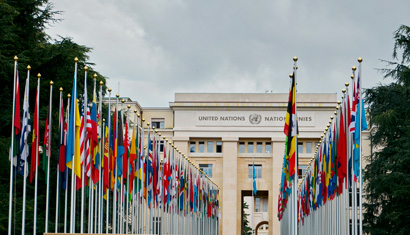
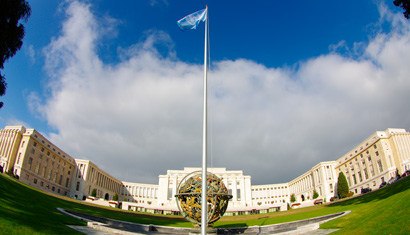
Our strategic presence in Geneva sets us apart as the sole NGO exclusively committed to economic, social, cultural, and environmental rights. This permits us to play a pivotal role in promoting and protecting these rights globally.
Updated Working Paper - Human Rights Law Sources: UN Pronouncements on Extra-Territorial Obligations
Extra-territorial obligations (ETOs) are increasingly recognized as essential to ensuring a global framework built on human rights. As a consequence, civil society is demanding that ETOs be applied through human rights monitoring, enforcement, accountability and remedial mechanisms, resulting in a growing body of pronouncements enforcing ETOs in practice. This Working Paper, updated November 2015, outlines the application of extra-territorial obligations (ETOs) by United Nations mechanisms, including the Concluding Observations of Treaty Bodies, General Comments and Recommendations adopted by Treaty Bodies, and within the work of UN Special Procedures including Special Rapporteurs and Independent Experts appointed by the Human Rights Council. As such, it provides a current understanding of how ETOs are monitored and enforced by UN human rights mechanisms.
ESC Rights Update from Geneva: 30th session of the UN Human Rights Council, Fall 2015
September 2015
The 30th session of the Human Rights Council dealt with ESC and related rights issues such as: enforced or involuntary disappearances and economic, social and cultural rights; safe drinking water and sanitation; the education of girls; hazardous substances and wastes; indigenous peoples; capacity-building in public health against pandemics; human rights of peasants and persons working in rural areas; and the right to development.
We thank Alissa Noemie Ghils for her great work in assisting the Global Initiative for ESCR at the 30th session of the Human Rights Council and for authoring this version of our periodic Update from Geneva.
For a detailed report on Economic, Social and Cultural Rights at the 30th session of the Human Rights Council see here.
Geneva – By Bret Thiele, Co-Executive Director of the Global Initiative for Economic, Social and Cultural Rights, which undertakes advocacy in the area of extra-territorial human rights obligations.
Corporations and other business enterprises have a substantial impact on the world in which we live, including on human rights. According to the World Bank, in 2012, 63 per cent of the 175 largest global economic entities were corporations, and corporate activities have impact on human rights around the globe. Consequently, human rights defenders have increasingly focused on developing tactics, strategies and mechanisms to hold corporate actors accountable to human rights obligations.
This advocacy has resulted in the human rights framework addressing this reality, including with two key initiatives. The first is the Guiding Principles on Business and Human Rights framework. The second is the move to a legally binding human rights treaty on corporate actors, an initiative which has emerged from strong civil society engagement. Both show various degrees of promise, but both also have drawbacks. The Guiding Principles are unfortunately crafted more as a corporate social responsibility framework rather than corporate accountability framework, as they are voluntary in nature, and they don’t apply the current comprehensive body of international law to corporate activity. And, while the process towards a legally binding treaty is welcomed and much needed, it will be some time before such a treaty is adopted and enters into force.
Fortunately, there presently is another means of holding corporate actors accountable by using the existing human rights framework, namely by holding States accountable to their respective obligations to protect human rights by directly regulating corporations and providing accountability and remedial mechanisms when those corporations do violate human rights. While the obligation to protect is well entrenched in the context of corporate activities at the domestic level, increasingly the extra-territorial obligation (ETO) to protect is being used to hold transnational corporations accountable for human rights impacts abroad.
Particularly driven by human rights defenders and civil society, the United Nations treaty bodies, those Committees mandated to monitor compliance with human rights treaties, have begun to seriously apply the extra-territorial obligation to protect human rights in the context of corporations and other business entities. For instance, building on earlier pronouncements, the Committee on Economic, Social and Cultural Rights, which monitors compliance with the International Covenant on Economic, Social and Cultural Rights, adopted its clearest articulation on the ETO to protect in the context of corporate accountability, expressing its concern “about the lack of adequate and effective measures adopted by the State party to ensure that Chinese companies, both State-owned and private, respect economic, social and cultural rights, including when operating abroad” and recommending that China:
(a) Establish a clear regulatory framework for companies operating in the State party to ensure that their activities promote and do not negatively affect the enjoyment of economic, social and cultural human rights; and
(b) Adopt appropriate legislative and administrative measures to ensure legal liability of companies and their subsidiaries operating in or managed from the State party’s territory regarding violations of economic, social and cultural rights in their projects abroad.
The Human Rights Committee, which monitors compliance with the International Covenant on Civil and Political Rights, has also enforced ETOs in this context. For instance it recently adopted Concluding Observations on Canada in which it expressed its concern “about allegations of human rights abuses by Canadian companies operating abroad … and about the inaccessibility to remedies by victims of such violations.” The Committee also regretted “the absence of an effective independent mechanism with powers to investigate complaints alleging abuses by such corporations that adversely affect the enjoyment of the human rights of victims, and of a legal framework that would facilitate such complaints.” The Committee went on to recommend that Canada “a) enhance the effectiveness of existing mechanisms to ensure that all Canadian corporations, in particular mining corporations, under its jurisdiction respect human rights standards when operating abroad; b) consider establishing an independent mechanism with powers to investigate human rights abuses by such corporations abroad; c) and develop a legal framework that affords legal remedies to people who have been victims of activities of such corporations operating abroad.”
The challenge now for human rights defenders is to keep this momentum going and to leverage these pronouncements with national level advocacy in order to achieve real positive change on the ground. Also, however, a concerted advocacy push should include the ETO to fulfill rights, by ensuring that corporate actors not only refrain from rights violations, but are required to ensure that their activities, including activities abroad, further the enjoyment of human rights around the globe.
For a comprehensive collection of UN pronouncements on extra-territorial obligations, including from treaty bodies, see the Global Initiative for Economic, Social and Cultural Rights’ Working Paper on UN Pronouncements on ETOs.
Civil Society call for Gender Balance on Committee on Economic, Social and Cultural Rights
Today the Global Initiative for Economic, Social and Cultural Rights and the Programme on Women's Economic, Social and Cultural Rights were joined by 18 other civil society organizations in calling on Geneva and New York Missions to support gender balance and expertise in women's economic, social and cultural rights on the Committee on Economic, Social and Cultural Rights.
Currently the membership of the Committee consists of 15 men and 3 women. This is concerning because it provides a poor example of gender balance in an important human rights body and it highlights a systemic problem in surfacing, pursuing and promoting highly qualified female candidates for membership to the Committee. It is also clearly inconsistent with the human rights principles of nondiscrimination and equality between men and women, which are enshrined in the United Nations Charter and the Universal Declaration of Human Rights and of all the major international human rights treaties including the International Covenant on Economic, Social and Cultural Rights.
As mentioned above, the letter also calls for the support of candidates with established track records on women’s economic, social and cultural rights. This is crucial as today women represent approximately 70% of the 1.2 billion people living in poverty throughout the world and violations of women's economic, social and cultural rights contributes substantially to the continuing subordination of women.
Finally, the letter urges that all members of the Committee be independent of States and impartial in their Committee work.
On September 17, 2015, the UN Committee on Economic, Social and Cultural Rights (CESCR) published its first recommendations in response to an individual complaint, regarding a violation of the right to housing, under the Optional Protocol to the International Covenant on Economic, Social and Cultural Rights (OP-ICESCR), taking into account an ESCR-Net intervention.
With its entry into force in May 2013, the OP-ICESCR gave the CESCR the ability to hear complaints from individuals or groups of individuals who have not been able to secure justice for violations of economic, social and cultural rights (ESCR) in their own country. This case sets an important precedent, representing a vital new opening for access to justice at the international level, following the advocacy of the NGO Coalition for the Ratification of the OP-ICESCR.
In I.D.G. v. Spain (Communication 2/2014), brought on behalf of the complainant by FR Abogados, the CESCR established that the State has the obligation to provide for effective remedies in foreclosure procedures related to defaulting on mortgage payments, to ensure that all appropriate measures are taken to guarantee personal notification in foreclosure procedures, and to guarantee that legislative measures are adopted to prevent repetition of similar violations in the future.
The Committee ruling is in line with the third party intervention, presented by the International Network for Economic, Social and Cultural Rights (ESCR-Net) through members of its Strategic Litigation Working Group - the Global Initiative for Economic, Social and Cultural Rights (GI-ESCR), the Center for Economic and Social Rights (CESR), and the Social Rights Institute of South Africa (SERI) - referencing established principles and relevant interpretation of such principles through international and comparative case law and other sources. It stressed that States parties must interpret and apply domestic law consistent with their obligations under the ICESCR and must ensure effective judicial protection for Covenant rights, including the right to adequate housing. The latter protection entails state obligations to consider all feasible alternatives to eviction, ensure the greatest possible security of tenure, provide for adequate and reasonable notice in cases of eviction, ensure that evictions do not render persons vulnerable to other human rights violations, and provide adequate compensation for violations. In accepting this intervention from ESCR-Net, GI-ESCR, CESR and SERI, the Committee has followed the practice set by other international and regional decision-making bodies in allowing for third party interventions which present material relevant to the issues at stake.
This case arises in circumstances of widespread threats to the right to housing, impacting large numbers of people in Spain, who lost their homes after defaulting on mortgage payments in the context of the country’s economic recession and substantial unemployment. In this regard, an estimated 400,000 mortgage foreclosures took place in Spain between 2008 and 2012.[1] In 2014, six million people were unemployed in Spain. Moreover, between 2010 and 2014, the national budget for housing decreased by 47%, according to official figures.[2]
This case represents an important opening for justice for individuals and groups affected by ESCR violations; however, countries must first ratify the OP-ICESCR before their residents can access the CESCR using the mechanism of communications. Civil society, foremost via the NGO Coalition for the OP-ICESCR coordinated by ESCR-Net, was central to the drafting and adoption of the OP-ICESCR, and the Coalition continues an active campaign encouraging countries to ratify and reinforce their existing human rights obligations by ensuring access to effective remedy. As at today’s date, the following countries had ratified the OP-ICESCR: Argentina, Belgium, Bolivia, Bosnia and Herzegovina, Cabo Verde, Costa Rica, Ecuador, El Salvador, Finland, France, Gabon, Italy, Luxembourg, Mongolia, Montenegro, Niger, Portugal, San Marino, Slovakia, Spain and Uruguay.
[1] Observatori DESC and Plataforma de los afectados por la hipoteca. Housing emergency in Spain. The crisis of foreclosures and evictions from a human rights perspective (2013). Available here.
[2] CESCR. Visualizing Rights Fact Sheet No. 14 – Spain (2014), available here.
Honduras: Oppression against Economic, Social and Cultural Rights defenders must end
The specific and increasingly heightened risks facing defenders of economic, social and cultural rights in Honduras should be a priority issue during the country’s forthcoming examination by the UN Committee on Economic, Social and Cultural Rights, ISHR has said in a joint NGO report.
While all human rights defenders in Honduras are exposed to a wide range of obstacles and risks, those working on economic, social and cultural rights (land and environmental defenders in particular) are among the most vulnerable, shows the report on the situation of human rights defenders in Honduras. The research has been published jointly by ISHR, the International Platform against Impunity and the Global Initiative for Economic, Social and Cultural Rights (GI-ESCR).
Violence and pressure are used on a regular basis to impede their work and silence them, which includes:
Death threats and murders
Forced evictions
Arbitrary detention and fraudulent charges
Administrative restrictions against the right to assembly
Public stigmatisation and defamation
Enforced disappearances
These attacks carried out in a climate of complete impunity have severely damaged the space for civil society activism regularly deprived of its most vocal representatives and haunted by the fear of reprisals.
The 56th Pre-sessional Working Group of the UN Committee on Economic, Social and Cultural will consider the joint submission in developing a list of issues to be posed to Honduras at its next examination. The aim of the review will be to assess Honduras’ progress towards compliance with the International Covenant on Economic, Social and Cultural Rights.
Dangers escalate for economic, social and cultural rights defenders
Despite the development of some encouraging laws, policies and actions by the authorities towards better protection of defenders, much more is required to ensure their full implementation while ‘a series of laws still restrict the rights to freedoms of assembly and association,’ says Ben Leather, ISHR Advocacy and Communications Manager.
‘It is clear that this group represents some of the human rights defenders who are most vulnerable in Honduras, given that they face a broad range of threats from a broad range of actors,’ he says. ‘The government must take steps to recognise their important role in ensuring economic development benefits communities and respects human rights, whilst protecting them against any reprisals for their activism.’
The Pre-sessional Working Group of the UN Committee on Economic, Social and Cultural Rights must ask Honduras to detail the legal and practical steps it intends to take in order to ensure effective protection of economic, social and cultural rights defenders and combat impunity.
Lucy McKernan, Geneva Representative for GI-ESCR said: 'We hope the Committee will emphasise that inherent in the economic, social and cultural rights of Honduran citizens are the rights to participate in decisions that affect them, to critique government policy and advocate for changes in relation to those rights, without fear of harassment or reprisals.’
Angola: Law should not be an instrument to stifle Economic, Social and Cultural Rights defenders
In a joint report sent to the UN Committee on Economic, Social and Cultural Rights, the GI-ESCR and ISHR shed light on the judicial pressure and other means used by the Angolan Government to silence defenders.
The report published by ISHR and the Global Initiative for Economic, Social and Cultural Rights (GI-ESCR) on the situation of human rights defenders in Angola reveals the particularly fragile situation of economic, social and cultural rights defenders in Angola and the recurrent misuse of judicial instruments and procedures by Government authorities to hamper and even block their action.
An increasingly restrictive legal environment and arbitrary application of the law combine to make the working context for human rights defenders in general, and economic, social and cultural rights defenders in particular, both unsafe and disempowering. This includes:
Arbitrary arrests and detention
Judicial harassment, abusive lawsuits and sentences
Legal restrictions to freedom of association
Purposely long and complex registration process for NGOs
Intimidation and violence by police officers
Defamation and criminalisation of defenders
Ban threats for organisations and defenders setting up protests
Journalists reporting on economic, social and cultural rights and defenders demanding transparency and disclosing governmental corruption are among the most exposed to these violations.
The 56th Pre-sessional Working Group of the UN Committee on Economic, Social and Cultural Rights will consider the joint submission by ISHR and the Global Initiative for Economic, Social and Cultural Rights in developing a list of issues to be posed to Angola at its next examination. The aim of the review will be to assess Angola’s progress towards compliance with the International Covenant on Economic, Social and Cultural Rights.
Warning lights on for civil society freedoms
In a latest move to keep watch over civil society organisations, the Government recently used counter terrorism as a pretext to enact a presidential decree that made it almost impossible for NGOs to carry out a wide range of procedures such as receiving foreign funding or acquiring legal personality. As for activists, those ‘defending labour rights and the right to housing, health, development and public participation in the context of business operations, face both restrictions in terms of access to information and transparency, as well as attacks and criminalisation in response to their work’, underlines Ben Leather, ISHR Advocacy and Communications Manager.
Lucy McKernan, Geneva Representative for GI-ESCR explained that ‘the effective protection and realisation of economic, social and cultural rights relies upon the valuable contribution of civil society, by monitoring and evaluating State compliance with the Covenant, providing input into policy formulation and program design and holding decision-makers accountable. States must ensure that civil society can play this vital role, and can voice their critiques of government action without fear of reprisals.’
The Pre-sessional Working Group of the UN Committee on Economic, Social and Cultural Rights must therefore ask Angola to indicate what legal and policy steps it intends to take in order to relax undue governmental oversight and de facto restrictions imposed on civil society action.
Responding to The Economist’s articles in support of private education: 7 letters from academics and NGOs
The 1st August 2015 edition of British weekly newspaperThe Economist published two articles on the growth of private education in developing countries: “Learning Unleashed” and “The $1-a-week school”. The articles purport the alleged benefits of the low-fee private school model. Both pieces came strongly in favour of private education, calling on governments to either help private schools or “get out of their way”. The articles generated a number of responses from organisations and individuals across the globe. A selection of these was published in the 22nd August edition’s Letters section, both in print and online, but not all responses were included.
Together with other organisations, we put together a short document collating the brief responses submitted to The Economist, including several that were not published. The document is available here http://bit.ly/1VX9LuW
Land Rights: An Essential Global Indicator for the Post-2015 Sustainable Development Goals
Secure land rights for all are a critical component of a transformational agenda of the Post-2015 Sustainable Development Goals (SDGs) and targets. Leveraging decades of extensive expertise, a broad coalition of global and national organizations, civil society, and experts, including the United Nations Environment Program (UNEP), the Women’s Major Group (WMG), the International Union for Conservation of Nature (IUCN), and the UN Sustainable Development Solutions Network (SDSN), recommends the following Land Rights Indicator.
Universal and feasible, this recommended land rights indicator is vital to four of the sustainable development goals, including ending poverty (goal 1), ensuring food security (goal 2), achieving gender equality and empowering women (goal 5), and making cities and human settlements inclusive (goal 11).1 This indicator, best placed under Target 1.4, would capture gender equality and progress of all people’s on-the-ground rights to land, property, and natural resources. This land rights indicator further aligns with priority indicators issued by the Global Land Indicators Initiative, and supported by the Global Donor Working Group on Land.
Recommended Land Rights Indicator:Percentage of women, men, indigenous peoples, and local communities (IPLCs) with secure rights to land, property, and natural resources, measured by:
a. percentage with legally documented or recognized evidence of tenure, and
b. percentage who perceive their rights are recognized and protected
The recommended indicator focuses on the twin aims of tracking legal and administrative progress by governments in recognizing secure rights to land (documentation) and of people-defined progress on the quality of land rights (perceptions). In doing so, this indicator fully tracks the agenda’s land rights content developed through months of inclusive negotiation and consultation and satisfies the request in the recently finalized UN declaration that global indicators maintain the level of ambition of the agenda (Para. 75).
The land rights indicator must capture the full scope of land rights included in the Post-2015 SDGs
Sustainable Development Goal 1 aims to “End poverty in all its forms everywhere.” One of the pillar targets to that end, Target 1.4, calls for “By 2030, ensure that all men and women, in particular the poor and the vulnerable, have equal rights to economic resources, as well as access to basic services, ownership and control over land and other forms of property, inheritance, natural resources, appropriate new technology and financial services, including microfinance.” This target encompasses all people regardless of where they reside, their livelihood activities, or the assets they own. It covers both social and economic resources.
a) The land rights indicator must capture more than agricultural land: Secure rights to land are key to accessing income, food, status, housing, credit, government services, and greater household- and community-level decision-making.
Indicators limited to agricultural land ignore the millions of women, men, indigenous peoples and local communities (IPLCs) who live in the forest, practice nomadic or semi nomadic pastoralism, rely on plots too small to be considered agricultural holdings, live in rural areas but are not engaged in agricultural production, reside on communal land not designated for agricultural purposes, or rely on land for small businesses, as well as the urban and peri-urban poor.
b) The land rights indicator must extend beyond ownership: The indicator should use “tenure security,” a widely accepted concept that encompasses more than ownership and is in line with FAO’s Voluntary Guidelines on the Responsible Governance of Tenure. Using “tenure security” (or “secure land rights”) terminology would protect the rights of those who access land through a number of group- or individually-held tenure arrangements. Indicators limited to those who “own” land ignore the millions:
• who live in countries, such as China and Vietnam, where the State owns all the land, and individuals have use rights. • who reside in regions across the world on communally-held land not individually-owned, such as areas under customary tenure in Sub-Saharan Africa, indigenous territories in Latin America, and Tribal communities in India. • who are unable to afford to own land but require secure use rights.
c) The land rights indicator must track both gender ratio and overall progress: Indicators limited to tracking the gender gap among those who have secure rights fail to consider the millions of women, men and IPLCs who do not have secure rights to land. The recommended land rights indicator would track both absolute improvement and reduced gender inequality.
A transformational agenda should seek new data and not be constrained by already available data
While critical to inform policy and to track progress, there is no globally available, nationally representative, sex-disaggregated data on land rights. Thus, any indicator on land rights will require new data collection efforts. The post-2015 agenda presents a historic opportunity to push the data and evidence base forward, rather than having the available data control the framing of priorities.
The recommended land rights indicator is feasible, even in the short term. For a description of how the data void can be addressed through global polls and household surveys click here.
For more information on the coalition’s proposal, click here. For questions or suggestions, please contact us at This email address is being protected from spambots. You need JavaScript enabled to view it.
1 The cross-cutting nature of the recommended indicator, which can also track progress towards targets 2.3, 5.a and 11.1, makes it a powerful option if there is pressure to settle for a manageable set of indicators without sacrificing key components of the agenda.
The full statement along with sponsoring and endorsing organizations can be found HERE.
Ana Clara works as a Programme Officer on Public Services with the Global Initiative for Economic, Social, and Cultural Rights. She holds a master’s degree in Human Rights and Humanitarian Action from Sciences Po in Paris, where she focused on economic, social, and cultural Rights, and Latin American and gender studies. She holds a Bachelor of Laws from Universidade Federal de Mato Grosso in Brazil.
Ana Clara previously worked on litigation claims concerning the right to social security and the right to health at the Public Defender’s Office and Federal Court of Justice in Brazil. She also supported the work of the Special Rapporteur on Economic, Social, Cultural, and Environmental Rights of the Inter-American Commission on Human Rights. Recently, she worked on strategic litigation before the Inter-American Court of Human Rights as part of the team of the Center for Justice and International Law.
Ana Clara, country is Brazil (Based in Paris).
ASHINA MTSUMI
PROGRAMME OFFICER -PUBLIC SERVICES & REPRESENTATIVE FOR AFRICA
Ashina works as the Programme Officer for Public Services and Representative for Africa with the Global Initiative for Economic, Social and Cultural Rights. She is an Advocate of the High Court of Kenya, with an LL.B degree from the University of Nairobi, Kenya, and an LL.M (with distinction) in Human Rights and Democratisation in Africa from the Centre for Human Rights, University of Pretoria, South Africa.
Passionate about social justice, she has worked in the human rights sector for over six years at the intersection of global and national struggles for just systems of public service delivery to ensure everyone can enjoy their socio-economic rights, first at the Economic and Social Rights Centre-Hakijamii in Kenya and then at GI-ESCR. In particular, she has led and supported research and advocacy at local, national and global research and advocacy focused on the human rights legal framework relating to the rights to land, housing, education, health and water, for marginalised communities. Her research interests also include human rights and economic policy and the contribution that human rights obligations can make to the formulation and implementation of economic policy.
Ashina is based in Nairobi, Kenya.
BELÉN QUELLET
SENIOR COMMUNICATIONS OFFICER
Belén has a BA in International Relations. She lived in India and the Philippines just after graduating where she volunteered for three years in health and education projects. Upon her return to Argentina, where she is native from, she joined Red Solidaria as volunteer and international aid coordinator. She worked as a journalist and program manager at La Nación newspaper foundation in Buenos Aires, to later become Social Media information specialist at the US Embassy in Buenos Aires. She acted there as Liaison Officer with other sections and became Grant Officer representative. She was selected to become HelpArgentina's Executive Director to help expand fundraising opportunities abroad for NGOs from other Latin American countries, and successfully transitioned the organization into PILAS, Portal for Investment in the Latin American Social Sector. From there she moved on to working at a new media startup, RED/ACCION, as Engagement Editor and Membership coordinator before joining us as Communications Officer.
Belén is based in Buenos Aires, Argentina.
LORENA ZENTENO
RESEARCH ASSOCIATE
Lorena Zenteno is a PhD student at the University of Edinburgh. Her primary research interests include the human rights dimensions of climate change and environmental impacts, climate change justice, gender, and the judiciary’s role in the climate change crisis. Lorena has worked for several years in Chile, as a judge, as a law clerk, in the Court of Appeal of Concepcion, Santiago and in the Constitutional Chamber of the Supreme Court of Chile. She is a member of the Environment and Human Rights Commission of the National Association of the Chilean Judiciary, dedicated to study and discuss climate change and environmental impacts on human rights. Lorena is the Chilean National Rapporteur on Global Climate Litigation database for the Sabin Center for Climate Change Law of Columbia University.
She was a senior researcher for the former UN Special Rapporteur on Cultural Rights, Karima Bennoune, from September 2018 until September 2021. Supported and assisted the UN Special Rapporteur to fulfil his mandate to the UN General Assembly and UN Human Rights Council.
She holds an LL.B. from Universidad de Concepcion, a LL.M. in Environmental Law from the University of Davis, California, and a Master in Business Law from the University Pompeu Fabra, Barcelona, Spain. Lorena is a member of the the Global Network for the Study of Human Rights and the Environment.
Lorena is based in Geneva, Swiss.
ZSUZSANNA NYITRAY
PROGRAMME OFFICER -RIGHT TO EDUCATION
Zsuzsanna works as Right to Education Officer with the Global Initiative for Economic, Social and Cultural Rights. Prior to joining GI-ESCR, she assisted in the drafting process of the Abidjan Principles on the Right to Education and the development and publication process of the Commentary of the Abidjan Principles as a consultant. Previously, she has worked with the Open Society Justice Initiative as an Aryeh Neier Fellow on issues such as equality and non-discrimination, Roma rights, the right to education, economic justice, access to justice and the rule of law. She has also worked as a lawyer with the Hungarian Civil Liberties Union on educational segregation, Roma rights and hate crimes. She holds an LL.M in Public International Law from the University of Edinburgh and a Law Degree from the Eötvös Loránd University Budapest.
Zsuzsanna is based in Budapest, Hungary.
DONATE
If you enjoy our work, please consider making a donation!
No amount is too small. Your contribution will help us fight for transformative change to end endemic problems of social and economic injustice.
The Global Initiative for Economic, Social and Cultural Rights is a 501(c)(3) non-profit organisation. Donations are tax-deductible in many countries, including the United States.
MAGDALENA ROCHI
PROGRAMME OFFICER - CLIMATE AND ENVIRONMENTAL JUSTICE
Magdalena works as Programme Officer on Climate and Environmental Justice for the Global Initiative for Economic, Social and Cultural Rights. She is an international lawyer working on the intersections between human rights, environmental and economic law. Prior to joining GI-ESCR, she worked dealing with the protection of economic and social rights in Argentina, at an NGO focused on strategic litigation and as a clerk in the judiciary. She holds an LL.B. and a JD from the University of Buenos Aires, Argentina, where she specialised in International Law and an LL.M from the Geneva Academy of International Humanitarian Law and Human Rights, Switzerland.
Magdalena is based in Buenos Aires, Argentina.
ASHINA MTSUMI
OFICIAL DE PROGRAMA - SERVICIOS PÚBLICOS Y REPRESENTANTE PARA ÁFRICA
Ashina es oficial del Programa para los Servicios Públicos y Representante para África de la Global Initiative for Economic, Social and Cultural Rights. Es abogada de la Corte Suprema de Kenia, egresada (LL.B) de la Universidad de Nairobi, Kenia, y con un máster (LL.M) en derechos humanos y democratización en África, completado con honores, en el Centro para los Derechos Humanos de la Universidad de Pretoria en Sudáfrica. Ashina es una apasionada de la justicia social, y ha trabajado en el área de los derechos humanos en el marco de las luchas nacionales y mundiales por sistemas más justos de prestación de servicios públicos, que garanticen a todos el disfrute de sus derechos socioeconómicos. Primero trabajó en el Economic and Social Rights Centre de Hakijamii, Kenia, y luego, en el GI-ESCR. Concretamente, ha dirigido y apoyado la investigación y la defensa, a nivel local, nacional y mundial, del marco legal de derechos humanos para los derechos de las comunidades marginadas a la tierra, la vivienda, la educación, la salud y el agua. Sus intereses en la investigación se orientan también a los derechos humanos y las políticas económicas, así como a la contribución que el cumplimiento de los derechos humanos hace a la formulación y ejecución de las políticas económicas.
Ashina reside en Nairobi, Kenia.
ZSUZSANNA NYITRAY
OFICIAL DE PROGRAMA - DERECHO A LA EDUCACIÓN
Zsuzsanna es oficial del Programa de Derecho a la Educación de la Global Initiative for Economic, Social and Cultural Rights. Antes de unirse a GI-ESCR, colaboró, como consultora, en la redacción de los Principios de Abiyán sobre el derecho a la educación, así como en la elaboración y publicación del Comentario de los Principios de Abiyán. Previamente, Zsuzsanna trabajó con la Open Society Justice Initiative como becaria de la Aryeh Neier Fellowship, en temas como la igualdad y la no discriminación, los derechos de los romaníes (Roma Rights), el derecho a la educación, la justicia económica, el acceso a la justicia y el estado de derecho. También ha trabajado como abogada con la Hungarian Civil Liberties en la segregación educativa, los derechos de los Romaníes y los crímenes de odio. Tiene un máster (LL.M) en derecho público Internacional por la Universidad de Edimburgo y una licenciatura en Derecho por la Universidad Eötvös Loránd, Budapest.
Zsuzsanna reside en Budapest, Hungría.
BELÉN QUELLET
SENIOR AGENT DE COMMUNICATION
Belén est titulaire d’un BA en relations internationales. Juste après avoir obtenu son diplôme, elle a vécu en Inde et aux Philippines, où elle s'est portée volontaire pendant trois ans pour des projets de santé et d'éducation. À son retour en Argentine, d'où elle est originaire, elle a rejoint Red Solidaria en tant que volontaire et coordinatrice de l'aide internationale. Elle a travaillé comme journaliste et responsable de programme à la fondation du journal La Nación à Buenos Aires, pour devenir ensuite spécialiste de l'information sur les médias sociaux à l'ambassade des États-Unis à Buenos Aires. Elle y a joué le rôle d'agent de liaison avec les autres sections et est devenue représentante des agents de subvention. Elle a été choisie pour devenir la directrice exécutive de HelpArgentina afin d'aider à développer les possibilités de collecte de fonds à l'étranger pour les ONG d'autres pays d'Amérique latine, et a réussi la transition de l'organisation vers PILAS, le portail d'investissement dans le secteur social latino-américain. Elle a ensuite travaillé pour une start-up de nouveaux médias, RED/ACCION, en tant que rédactrice chargée de l'engagement et coordinatrice des membres, avant de nous rejoindre en tant que responsable de la communication.
Belén vit à Buenos Aires, en Argentine.
ANA CLARA CATHALAT
OFICIAL ASOCIADO DE PROGRAMA- SERVICIOS PÚBLICOS
Ana Clara Cathalat colabora como socia en la Global Initiative for Economic, Social, and Cultural Rights, mientras prosigue con su máster en derechos humanos y acción humanitaria en la Universidad Sciences Po, París. Allí centra su interés en los derechos económicos, sociales y culturales y en estudios de género en América Latina. Tiene una licenciatura en derecho por la Universidad Federal de Mato Grosso, Brasil.
Previamente, Ana Clara trabajó en reclamaciones judiciales relacionadas con el derecho a la seguridad social y el derecho a la salud en la Oficina del Defensor Público y el Tribunal Federal de Brasil. Asimismo, apoyó la labor del Relator Especial en Derechos Económicos, Sociales, Culturales y Ambientales de la Comisión Interamericana de Derechos Humanos. Recientemente, trabajó en litigios estratégicos ante la Corte Interamericana de Derechos Humanos, como miembro del equipo del Centro por la Justicia y el Derecho Internacional.
Ana Clara, Brasil. (Reside en París).
LORENA ZENTENO
INVESTIGADORA ASOCIADA
Lorena Zenteno es estudiante de doctorado en la Universidad de Edimburgo. Entre sus principales intereses de investigación se encuentran el impacto del cambio climático y su efecto ambiental sobre los derechos humanos, la justicia ambiental, el género y el papel del sistema de justicia en la crisis por el cambio climático. Trabajó varios años en Chile como jueza y como asistente jurídico en la Corte de Apelaciones de Concepción, Santiago, y en la Sala Constitucional de la Corte Suprema de Chile. Es miembro de la Comisión de los Derechos Humanos y Ambientales de la Asociación Nacional de Magistrados y Magistradas de Chile, la cual se dedica a estudiar el impacto del cambio climático y su efecto ambiental sobre los derechos humanos. Lorena es la relatora nacional chilena de la base de datos de los litigios por el cambio climático del Sabin Center for Climate Change Law de la Universidad de Columbia.
Trabajó como investigadora principal para la Relatora Especial sobre los Derechos Culturales de las Naciones Unidas, Karina Bennoune, desde septiembre de 2018 hasta septiembre de 2021. Apoyó y asistió al Relator Especial de las Naciones Unidas en sus labores ante la Asamblea General y el Consejo de Derechos Humanos de las Naciones Unidas.
Tiene una licenciatura en derecho por la Universidad de Concepción, un máster en derecho ambiental por la Universidad de Davis, California, y un máster en derecho empresarial por la Universidad Pompeu Fabra en Barcelona, España. Lorena es miembro de la Global Network for the Study of Human Rights and the Environment.
Lorena reside en Ginebra, Suiza.
MAGDALENA ROCHI
PROGRAMME OFFICER - CLIMATE AND ENVIRONMENTAL JUSTICE
Magdalena works as Programme Officer on Climate and Environmental Justice for the Global Initiative for Economic, Social and Cultural Rights. She is an international lawyer working on the intersections between human rights, environmental and economic law. Prior to joining GI-ESCR, she worked dealing with the protection of economic and social rights in Argentina, at an NGO focused on strategic litigation and as a clerk in the judiciary. She holds an LL.B. and a JD from the University of Buenos Aires, Argentina, where she specialised in International Law and an LL.M from the Geneva Academy of International Humanitarian Law and Human Rights, Switzerland.
Magdalena is based in Buenos Aires, Argentina.
DONATE
Si le gusta nuestro trabajo, considere hacer una donación.
Ninguna cantidad es demasiado pequeña. Su contribución nos ayudará a luchar por un cambio transformador para poner fin a los problemas endémicos de la injusticia social y económica.
La Global Initiative for Economic, Social and Cultural Rights es una organización sin fines de lucro 501(c)(3). Las donaciones son deducibles de impuestos en muchos países, incluyendo Estados Unidos.
This website uses cookies to enhance your browsing experience.
OFICIAL DE PROGRAMA - SERVICIOS PÚBLICOS Y REPRESENTANTE PARA ÁFRICA
Ashina es oficial del Programa para los Servicios Públicos y Representante para África de la Global Initiative for Economic, Social and Cultural Rights. Es abogada de la Corte Suprema de Kenia, egresada (LL.B) de la Universidad de Nairobi, Kenia, y con un máster (LL.M) en derechos humanos y democratización en África, completado con honores, en el Centro para los Derechos Humanos de la Universidad de Pretoria en Sudáfrica. Ashina es una apasionada de la justicia social, y ha trabajado en el área de los derechos humanos en el marco de las luchas nacionales y mundiales por sistemas más justos de prestación de servicios públicos, que garanticen a todos el disfrute de sus derechos socioeconómicos. Primero trabajó en el Economic and Social Rights Centre de Hakijamii, Kenia, y luego, en el GI-ESCR. Concretamente, ha dirigido y apoyado la investigación y la defensa, a nivel local, nacional y mundial, del marco legal de derechos humanos para los derechos de las comunidades marginadas a la tierra, la vivienda, la educación, la salud y el agua. Sus intereses en la investigación se orientan también a los derechos humanos y las políticas económicas, así como a la contribución que el cumplimiento de los derechos humanos hace a la formulación y ejecución de las políticas económicas.
Ashina reside en Nairobi, Kenia.
ZSUZSANNA NYITRAY
RESPONSABLE DE PROGRAMME - DROIT À l’ÉDUCATION
Zsuzsanna travaille actuellement en tant que responsable du droit à l'éducation pour l'Initiative mondiale pour les droits économiques, sociaux et culturels. Avant de rejoindre GI-ESCR, elle a participé, en tant que consultante, au processus de rédaction des Principes d'Abidjan sur le droit à l'éducation et au développement et à la publication du Commentaire des Principes d'Abidjan. Auparavant, elle a travaillé avec l'Open Society Justice Initiative en tant que boursière Aryeh Neier sur des questions telles que l'égalité et la non-discrimination, les droits des Roms, le droit à l'éducation, la justice économique, l'accès à la justice et l'État de droit. Elle a également travaillé en tant qu'avocate pour l'Union hongroise des libertés civiles sur la ségrégation scolaire, les droits des Roms et les crimes haineux. Elle est titulaire d'un master en droit international public de l'Université d'Édimbourg et d'un diplôme de droit de l'Université Eötvös Loránd de Budapest.
Zsuzsanna vit à Budapest, en Hongrie.
ANA CLARA CATHALAT
CHARGÉE DE PROGRAMME ASSOCIÉE – SERVICES PUBLICS
Ana Clara Cathalat collabore actuellement, dans le cadre d’une bourse, à l’Initiative mondiale pour les droits économiques, sociaux et culturels, tout en préparant un master en droits de l'Homme et action humanitaire à Sciences Po Paris, où elle se spécialise en droits économiques, sociaux et culturels, ainsi qu’en études de genre et latino-américaines. Elle a une licence de droit de l’Université Fédérale du Mato Grosso au Brésil.
Ana Clara a auparavant travaillé sur des actions en justice relatives au droit à la sécurité sociale et au droit à la santé auprès du Bureau de l’aide juridictionnelle et de la Cour de justice fédérale du Brésil. Elle a également appuyé les travaux de la Rapporteuse spéciale sur les droits économiques, sociaux, culturels et environnementaux de la Commission interaméricaine des droits de l'Homme. Elle a récemment travaillé sur des actions en justice dans des cas stratégiques auprès de la Cour interaméricaine des droits de l'Homme, au sein de l’équipe du Centre pour la Justice et le Droit International (CEJIL).
Ana Clara, le pays est le Brésil (Basée à Paris).
LORENA ZENTENO
ASSOCIÉE DE RECHERCHE
Lorena Zenteno est doctorante à l’Université d’Édimbourg. Ses principaux thèmes de recherche sont les dimensions du changement climatique et des problèmes écologiques relatives aux droits de l'Homme, la justice climatique, le genre, et le rôle de la Justice dans la crise du changement climatique. Lorena a travaillé pendant plusieurs années au Chili, comme juge et comme légiste, auprès des Cours d’appel de Concepción et Santiago et de la Chambre constitutionnelle de la Cour suprême du Chili. Elle fait partie de la Commission de l’environnement et des droits de l'Homme de l’Association nationale de la magistrature chilienne, dont la mission est d’étudier et de débattre des conséquences du changement climatique et des problèmes écologiques sur les droits de l'Homme. Lorena est la Rapporteuse nationale chilienne sur la base mondiale des actions en justice climatiques pour le Centre Sabin pour le droit du changement climatique de l’Université de Columbia.
Elle a occupé le rôle de chercheuse principale pour l’ancienne Rapporteuse spéciale sur les droits culturels de l’ONU, Karima Bennoune, entre septembre 2018 et septembre 2021. Elle a appuyé et soutenu la Rapporteuse spéciale de l’ONU dans l’accomplissement de son mandat conféré par l’Assemblée générale de l’ONU et le Conseil des droits de l'Homme de l’ONU.
Elle a une licence de droit de l’Université de Concepción, un master en droit de l’environnement de l’Université de Davis (California) et un master en droit des affaires de l’Université Pompeu Fabra de Barcelone (Espagne). Lorena fait partie du Réseau mondiale pour l’étude des droits de l'Homme et de l’environnement.
Lorena vit à le Chili, basé à Genève.
DONNER
Si vous aimez notre travail, pensez à faire un don !
Aucun montant n'est trop petit. Votre contribution nous aidera à lutter pour un changement transformateur afin de mettre fin aux problèmes endémiques d'injustice sociale et économique.
L'Initiative mondiale pour les droits économiques, sociaux et culturels est une organisation à but non lucratif 501(c)(3). Les dons sont déductibles des impôts dans de nombreux pays, y compris aux États-Unis.
BELÉN QUELLET
SENIOR OFICIAL DE COMUNICACIONES
Belén es licenciada en Relaciones Internacionales. Apenas se graduó, vivió en la India y en Filipinas, donde fue voluntaria durante tres años en proyectos de salud y educación. Al regresar a su nativa Argentina se incorporó a la Red Solidaria como voluntaria y coordinadora de ayuda internacional. Trabajó como periodista y gestora de programas de la fundación del diario La Nación en Buenos Aires, para luego convertirse en especialista en información de medios sociales en la Embajada de Estados Unidos en Buenos Aires. Allí actuó como oficial de enlace con otras secciones y se convirtió en oficial representante de los programas de subvenciones. Fue seleccionada como Directora Ejecutiva de HelpArgentina con la función de ampliar las oportunidades de recaudación de fondos internacionales de las ONG de otros países latinoamericanos, y logró la transición exitosa de la organización hacia PILAS, Portal para la Inversión Social en Latinoamérica. De allí pasó a trabajar en una nueva empresa de medios de comunicación, RED/ACCION, como editora y coordinadora de membresías, antes de unirse al equipo de la GI-ESCR como oficial de comunicaciones.
Belén reside en Buenos Aires, Argentina.
CAMILA BARRETTO MAIA
DIRECTORA EJECUTIVA
Camila cuenta con más de 14 años de experiencia en abogacía a niveles nacional, regional y multilateral, especializándose en la supervisión de investigaciones y litigios sobre diversos temas de derechos humanos. Ha residido en Buenos Aires, donde trabajó en el Centro de Estudios Legales y Sociales (CELS), coordinando esfuerzos internacionales durante cuatro años. Camila posee una maestría en Administración Pública y Política Pública de la Fundación Getulio Vargas en San Pablo y una licenciatura en Relaciones Internacionales de la Universidad de Brasilia.
Camila reside en Brasilia, Brasil. .
ANA DI FILIPPO
RESEARCH ASSOCIATE
Ana Emilia Di Filippo is currently pursuing the qualifying Master’s to become a lawyer in Spain at the Universidad Carlos III de Madrid. She also holds two undergraduate degrees, having graduated with a Bachelor of Laws from IE University and with a Bachelor of Science in Politics, Psychology, Law and Economics (Major in Comparative Law) from the University of Amsterdam. During her studies, she specialised her research on International Tax Law, particularly focusing on its transformative power and its potential to achieve social justice worldwide. In this framework, her latest research assessed the potential of the United Nations Framework Convention on International Tax Cooperation to advance procedural and substantive justice in the international tax regime.
Ana is based in Madrid, Spain.
ANA DI FILIPPO
INVESTIGADORA ASOCIADA
Ana Emilia Di Filippo está cursando actualmente el Máster habilitante para ejercer como abogada en España en la Universidad Carlos III de Madrid. También posee dos títulos de grado, habiéndose graduado con un Grado en Derecho de IE University y con un Grado en Ciencias en Política, Psicología, Derecho y Economía (con especialización en Derecho Comparado) de la Universidad de Ámsterdam. Durante sus estudios, se especializó en investigación sobre Derecho Fiscal Internacional, enfocándose particularmente en su poder transformador y su potencial para lograr justicia social a nivel mundial. En este marco, su investigación más reciente evaluó el potencial de la Convención Marco de las Naciones Unidas sobre Cooperación Fiscal Internacional para promover la justicia procedimental y sustantiva en el régimen fiscal internacional.
Ana reside en Madrid, España.
ANA CAROLINA GONZÁLEZ ESPINOSA
BOARD MEMBER
Ana Carolina is the Senior Director for Programs at NRGI. She works closely with thematic and regional program staff to advance strategic priorities, specially on just transitions and fair and sustainable economic and energy transition pathways in fossil fuel producing countries. She oversights strategy and implementation in the engagement with women, youth and communities around social and environmental governance, as well as in approaches to capacity development and influencing. Ana Carolina has more than 20 years of academic and professional experience in development, especially in relation to resource governance, communities’ participation, climate change and the energy transition.
She has been a visiting researcher at Columbia University in New York and at the Universidad Católica in Peru. She is currently an associate researcher at the Universidad Externado de Colombia. She has worked as a research and project consultant with the United Nations Development Programme, the International Finance Corporation, the Inter-American Development Bank, Transparency International—Colombia, NRGI and the Stockholm Environment Institute. She was a member of the international board of directors of the Extractive Industries Transparency Initiative (EITI) and the national EITI committee in Colombia, and she co-founded a coalition of civil society organizations and a non-governmental organisation in the field of governance. Most recently, Ana Carolina worked as a senior program officer of the natural resource and climate change program of the Ford Foundation, where she managed grantmaking monitoring and convening activities for the global initiative. She actively contributed to donor collaborative platforms working on climate change, communities’ land rights, transparency, accountability and energy.
Ana Carolina is from Colombia. She holds a Ph.D. in political science and two master’s degrees—in development and in comparative politics—from the Institute of Political Studies (Sciences Po) in Paris, France, as well as a bachelor’s degree in government and international relations from Universidad Externado de Colombia. She is fluent in English, French and Spanish.
SARA ALESSI
INTERN
Sara is currently working with the Global Initiative for Economic, Social and Cultural Rights as an intern. She holds a master's degree in law from the University of Turin in Italy, where she specialised in International Law and her thesis was entitled 'Rape as a War Crime: the Case of the Conflict in Bosnia and Herzegovina', focusing on the legal and humanitarian dimensions of armed conflict and accountability mechanisms. Additionally, Sara is an LL.M. candidate from the Geneva Academy of International Humanitarian Law and Human Rights. Prior to joining GIESCR, she volunteered with an Ugandan NGO to contribute to the educational and emotional well-being of children by valuing the importance of the right to education.
Sara is based in Geneva.
ANGÉLICA ZAMORA
BOARD MEMBER
Angélica Zamora is a social justice expert with more than a decade of experience in political philanthropy supporting human rights, feminist, racial and intersectional justice movements globally. She served as a manager at the Open Society Foundations (OSF), where she led regional and global programs advancing human rights and democratic values across diverse political contexts. She has designed and directed initiatives in areas such as citizen security and violence reduction, human rights and democratic resilience, especially in Latin America and the Caribbean. Prior to her tenure at OSF, Angélica was a researcher and activist supporting Colombia’s peace process and served in the country’s reparations and humanitarian assistance agency, where she engaged with communities affected by historical inequality and violence to co-design and implement programs focused on victims’ rights and access to state services in conflict-affected territories.
Angélica is from Colombia. She obtained her law degree from the Universidad Nacional de Colombia, her LL.M. from American University's Washington College of Law and a degree in Transparency, Corruption and Accountability from the Centro de Derechos Humanos at the Universidad de Chile.
BENEDETTA PANAGIA
INTERN
Benedetta is currently an intern at the Global Initiative for Economic, Social and Cultural Rights. She holds a master’s degree in law from Roma Tre University in Italy, where she specialised in international law. Her thesis, “International Sanctions and Humanitarian Action in Light of UNSC Resolution 2664”, focused on the impact of sanctions on economic, social and cultural rights and on the humanitarian dimension of sanctioning regimes. Benedetta is also an LL.M. candidate at the Geneva Academy of International Humanitarian Law and Human Rights.
Benedetta is based in Geneva.
TATIANA ZINN
INTERN
Tatiana is a human rights researcher from the United States pursuing an M.A. in Human Rights Studies at Columbia University. Her work focuses on gender-based violence, conflict-related sexual violence, and international human rights law. Her current research examines ISIS’s use of sexual violence in Iraq and the role of gender-based violence in armed conflict.
Tatiana graduated with honors from UCLA with a B.A. in Global Studies. She has experience in survivor advocacy, human rights education, and research on issues related to gender, conflict, and international justice.
Benedetta is based in New York.
AMANDA DE BRITO
RESEARCH ASSOCIATE
Amanda holds a Master’s in Education Policies for Global Development from the Autonomous University of Barcelona (Erasmus Mundus) and a Bachelor’s degree in International Relations from the Federal University of Santa Catarina, Brazil. Her professional background includes roles at the International Organization for Migration in Geneva, where she supported knowledge management and evidence-based policy coordination, and at Education International in Brussels, where she led a systematic review on teacher mental health and wellbeing. She has a particular interest in public education policies and their human rights dimensions in Brazil and the broader Latin American context.
Ana is based in Barcelona, Spain.
AMANDA DE BRITO
INVESTIGADORA ASOCIADA
Amanda cuenta con un Máster en Políticas Educativas para el Desarrollo Global por la Universidad Autónoma de Barcelona (Erasmus Mundus) y una Licenciatura en Relaciones Internacionales por la Universidad Federal de Santa Catarina, Brasil. Su trayectoria profesional incluye funciones en la Organización Internacional para las Migraciones en Ginebra, donde apoyó la gestión del conocimiento y la coordinación de políticas basadas en evidencia, y en la Internacional de la Educación en Bruselas, donde lideró una revisión sistemática sobre la salud mental y el bienestar del personal docente. Tiene un interés particular en las políticas de educación pública y sus dimensiones de derechos humanos en Brasil y en el contexto latinoamericano en general.
Ana reside en Barcelona, España.
LINNÉA HANSEN
INTERN
Linnéa is a student assistant to Prof. Dr. h.c. Anne Peters at the Max Planck Institute for Comparative Public Law and International Law in Heidelberg, working as an intern for the Climate and Environmental Justice Programme. She studies law at Ruprecht-Karls University Heidelberg with a focus on public international law. Linnéa was a visiting master's student in Aberystwyth, Wales, where she studied International Human Rights. Her recent publications are focused on International Environmental Law and International Humanitarian Law.





.png)